Off-road forklifts for construction sites and rough terrain. High ground clearance and 4WD. Your specialist for rough terrain: Luibl Rental.
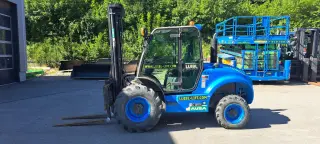
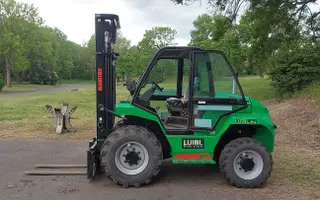
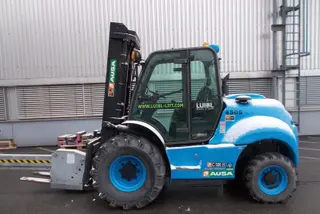
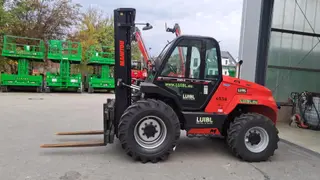
Rent All-Terrain Forklift!
Loose ground, mud after heavy rain, loads on grass: a standard industrial forklift won't get far here. All-terrain forklifts are built for exactly these conditions – with four-wheel drive, high ground clearance, and coarse-tread tyres. At Luibl, you can rent all-terrain forklifts from Ausa and Manitou with 3 or 5 tonnes load capacity, delivered throughout Europe by our own low-loader fleet.
Why Rent an All-Terrain Forklift?
The classic counterbalance forklift is designed for warehouses and paved traffic areas. As soon as the ground becomes soft, uneven, or sloped, it loses traction. All-terrain forklifts close this gap. They transport pallets, building materials, big bags, and machine parts wherever the asphalt ends.
Typical applications:
-
Construction sites: Shell-construction logistics on still-unpaved ground, material transport between the storage yard and the installation site, supplying work crews with stone, mortar, and steel.
-
Events: Setup at festival grounds, trade fair sites, and outdoor locations – anywhere the terrain is grass or gravel.
-
Agriculture and landscaping: Handling feed bales, fertiliser bags, and paving-stone pallets on farmyards and unpaved access roads.
-
Outdoor industrial storage: Steel yards, timber yards, recycling sites – areas with gravel or crushed-stone surfaces where standard forklifts reach their limits.
The distinction from an industrial forklift is clear: wherever wet conditions, slopes, or loose ground come into play, four-wheel drive determines productivity and safety.
Our Rental Fleet: All-Terrain Power from Ausa and Manitou
Luibl focuses on two manufacturers with a clear profile when it comes to all-terrain forklifts. Ausa is regarded as a compact all-rounder with a Spanish engineering tradition and a strong position in the mid load-capacity range. Manitou invented the all-terrain forklift and covers the entire spectrum from construction-site trucks to heavy-duty machines.
The compact all-rounder: Ausa C300H x4 (3 tonnes)
The Ausa C300H x4 is the entry point into the all-terrain forklift class. With a load capacity of 3,000 kg and a lift height of around 5 metres, it covers most tasks on medium-sized construction sites and outdoor storage areas. Its genuine four-wheel drive (x4) distributes drive power to all four wheels – making it reliable on gravel, grass, and wet ground.
What sets it apart from classic industrial forklifts: cornering control reduces travel speed depending on the turning radius, which lowers the risk of tipping when driving with a load on uneven terrain. The automatic fork-levelling system brings the mast back to precisely vertical – relevant for accurately picking up pallets on sloped ground. The roll-back prevention system stops the truck rolling backwards when pulling away from a ramp.
For construction sites with limited space or event logistics in confined areas, the C300H x4 is the right choice.
The powerhouse for major construction sites: Manitou M50-4 (5 tonnes)
The Manitou M50-4 raises the load limit to 5,000 kg – with a similarly lift height of around 5 metres. It is the machine for major construction sites, heavy-duty pallets, and handling bulky goods such as steel girders, stone consignments, or machine assemblies. Permanent four-wheel drive puts power on the tyres even at full load and on unfavourable ground.
The Manitou design features a clear-view mast for an unobstructed view of the load and a hydrostatic drive that allows precise manoeuvring. At full load, the lowering safety valve automatically regulates the lowering speed – a feature that, with heavy loads, makes the difference between controlled placement and material damage.
The load centre of gravity and stability of the M50-4 are designed for heavy loads in outdoor use. For bridge construction sites, infrastructure projects, and heavy-duty freight handling, it is the standard solution.
Technical Highlights: What All-Terrain Forklifts Need to Deliver
An all-terrain forklift is more than an industrial forklift with different tyres. Four factors determine its suitability for rough conditions.
Four-wheel drive (4x4): Unlike the front-wheel drive of a warehouse forklift, four-wheel drive powers all four wheels. This prevents individual wheels from spinning in mud, sand, or on turf. On slopes and when picking up a load from an uneven position, four-wheel drive delivers constant traction.
Ground clearance: All-terrain forklifts have significantly more clearance between the underbody and the ground than warehouse forklifts. Stones, kerbs, and uneven ground are driven over without the frame grounding out. This massively reduces damage to hydraulic lines and the underbody.
Coarse-tread tyres: The tyre is the interface with the ground. All-terrain forklifts run on air-filled, treaded tyres with a deep lug pattern. These dig into soft ground and provide sufficient grip on firm ground. Solid rubber tyres, as commonly used indoors, deliver no performance off-road.
Diesel drive: The diesel engine delivers the torque that heavy loads need across uneven terrain. Electric all-terrain forklifts are available for special applications, but most construction-site work still runs on diesel – due to runtime, power, and on-site refuelling.
Each of these features pays directly into productivity: a forklift that isn't stuck on site saves rental days and working time.
Safety and Qualification: What You Need to Know for Operation
All-terrain forklifts are industrial trucks within the meaning of DGUV Vorschrift 68. Operation is reserved for qualified personnel holding a forklift licence (operator's certificate per DGUV Grundsatz 308-001). Before first use on a construction site, an additional workplace-specific induction by the operating company is mandatory.
The annual inspection under the accident-prevention regulations (UVV) per BetrSichV is part of the vehicle documentation for all Luibl rental equipment. For long-term rentals, Luibl carries out the recurring inspection within the rental period. For Austria, the provisions of the AM-VO apply analogously; the equipment also meets the legal requirements there.
For operators without a valid forklift licence, Luibl offers its own training courses – conducted with a hands-on approach and examination per DGUV-Grundsatz.
Rental Process and Logistics: Europe-Wide Delivery by Luibl
Luibl operates its own low-loader fleet. This matters more for all-terrain forklifts than for most other machines: with four-wheel drive, high ground clearance, and counterweight, they are heavy and bulky. Relying on external hauliers frequently leads to delivery delays in practice.
How the rental process works:
-
Enquiry: You provide the site location, rental period, required load capacity, and ground conditions. Luibl uses this to recommend the right model – Ausa or Manitou, 3 or 5 tonnes.
-
Quote: Transparent rental terms with a clear breakdown. No hidden costs, no surprise line items. Long-term rentals include the accident-prevention regulations (UVV) inspection and maintenance as part of the package.
-
Delivery: Our own low-loader fleet delivers throughout Germany, Austria, Switzerland, Poland, Czechia, Italy, Hungary, and other European countries. Reliable scheduling – even for bulky, oversized equipment.
-
On-site support: Technicians are available on request. In the event of technical issues or operating questions, downtime is kept to a minimum.
-
Return: Timely collection at the end of the rental by the same low-loader fleet.
For construction sites and industrial customers in Hamburg, Passau, and the surrounding economic regions, delivery is handled at short notice, provided the machine is available.
FAQ – Frequently Asked Questions About Rough-Terrain Forklifts

Can I also use a rough-terrain forklift indoors?
What licence is required for a rough-terrain forklift?
What does it cost to hire a rough-terrain forklift?
When is an all-wheel-drive forklift necessary?
Which lifting capacity is the right one?
Conclusion: Request Your Individual Rental Quote Now
All-terrain forklifts are specialist equipment. The right choice between the Ausa C300H x4 and the Manitou M50-4, between 3 and 5 tonnes load capacity, and between short-term and long-term rental depends on your specific project. A consultation with Luibl brings the right machine to your site – including delivery scheduling, the accident-prevention regulations (UVV) inspection, and technical support.
Contact:
-
Phone: +49 (0) 851 756868-0
-
Email: [email protected]
-
Online enquiry: www.luibl.eu/en/contact/