Roof Work with a Mast Lift – Planning, Safety, Procedures
A blocked gutter, a crumbling chimney, a PV system at the eaves that needs inspecting – and the scaffolding would stand for three days before anyone even starts work. It is exactly for cases like these that the mast lift is often put forward as the quick solution. Rightly so, but only for certain tasks. Anyone who books a mast lift for roof work without knowing the limits of the machine sometimes finds themselves on the day of use with a machine that simply does not reach.
This article sets out honestly what the mast lift really is suited to for roof work, where its limits lie – and which alternative from the Luibl rental fleet steps in when more outreach or more height is needed.
What a Mast Lift Can Do Technically
Mast lifts such as the JLG Toucan or the Haulotte Star work purely vertically: a telescopic mast travels straight up, without a lateral boom arm. For use on a building this brings several advantages that have to work together for the rental to pay off at all. The working height reaches up to around 12.65 m, which depending on the building means up to three or four storeys – enough to reach the eaves of a detached house or a low apartment block directly. Because the tyres are non-marking, they leave no traces on paving stones, patio slabs or a paved driveway, which on private properties is often the real sticking point. The electric drive adds to this: it runs quietly and without exhaust fumes, which in residential areas or an inhabited courtyard makes a noticeable difference to whether the neighbours notice the job at all.
Size pays into the same advantage. Models such as the JLG Toucan fit through doorways under one metre wide and through property entrances that neither scaffolding nor a larger platform could pass. Because no scaffolding assembly and no permit procedure are required, the machine is often ready for use within a few minutes of the handover briefing. For localised work directly above its own footprint – that is, practically vertically above the point where the platform stands – that is a genuine, faster alternative to conventional scaffolding.
Where the Mast Lift Reaches Its Limits on Roof Work
Just as important as the strengths are the limits, because this is where most planning mistakes arise. A pure mast lift travels straight up and brings barely any lateral outreach – models with a jib manage a maximum of around 6 m sideways. With widely projecting roof overhangs, a bay window, or where a chimney sits in the middle of the roof, that is frequently not enough to actually reach the work position. Load capacity also limits the application: at around 200 kg in the basket there is room for one person plus tools, but not for transporting roof tiles, larger sheet metal parts or solar modules.
Then there is the ground. Mast lifts are not rough-terrain machines and need a firm, level standing position – lawns, gravel or a sloping property are generally ruled out. And even where height, outreach and ground all fit, one fundamental limit remains: the mast lift brings the operator up to the eaves or the verge, but not onto the pitched roof surface itself. For work in the middle of the roof it is simply the wrong machine. If any one of these restrictions applies, it is worth looking at a different machine from the Luibl rental fleet.
When a Different Platform Is the Better Choice
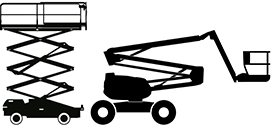
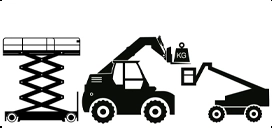
Where lateral outreach is required – over a canopy projection, around a bay window, or because the standing area is not directly beneath the work position – the articulating boom lift is the more appropriate choice. It reaches considerably greater working heights and bridges obstacles for which a mast lift is too inflexible (articulating boom lifts at Luibl Rental). If the problem lies with the ground instead – lawn, a slope, an unpaved garden or a courtyard with steps – the spider lift is the better solution. It is built for exactly this kind of terrain and is gentle on sensitive surfaces in the process (spider lifts at Luibl Rental).
Which machine ultimately fits comes down to three questions: how far does the platform have to reach sideways? What will the ground bear? And how heavy is what needs to be transported? If in doubt, we clarify this directly by phone using photos or a short site plan – usually that is enough to select the right machine up front rather than the obvious one.
Typical Applications and What Should Be Clarified Beforehand
In practice, the mast lift is a particularly good fit for gutter cleaning and repair on detached and multi-family houses with direct access from below, for maintaining PV systems in the easily reachable eaves area, for smaller facade and roof-junction work such as sealing at the verge, and for work on listed facades where scaffolding is to be avoided for planning-consent reasons. Tight courtyards into which neither scaffolding nor a larger vehicle will fit are another classic field of use.
So that no nasty surprise awaits on the day of use, a short check of the key points beforehand is worthwhile: the access width through gateway, doorway or courtyard; the load-bearing capacity of the ground – paving on a sand bed will not carry a heavy machine permanently, and load spreader plates help here if necessary; the actual working height and lateral outreach relative to the specific work position rather than to the bare building height; and the weather, because as with every aerial work platform there are operating limits in wind, which are discussed on site with the team.
Safety and Regulations
Mast lifts are subject to the same body of rules as other aerial work platforms. DGUV Rule 100-500 governs inspection intervals, operating requirements and maintenance intervals in Chapter 2.10, while DIN EN 280 as the safety standard for mobile elevating work platforms lays down everything essential from fall protection to the protection of hydraulic lines. For the operator, the IPAF/PAL Card is advisable and is required by many clients – we accept existing certificates and can arrange the training where needed. Every mast lift from the Luibl rental fleet also comes with a complete, up-to-date inspection log in accordance with the UVV accident prevention regulations.
How Renting a Mast Lift from Luibl Works
It starts with the enquiry, stating working height, lateral outreach, place of use and the planned period, ideally supplemented by a photo or a site plan. A quote including transport follows promptly, with any open questions about access and ground conditions clarified directly in advance. Delivery is made with our own fleet of low-loaders, and the operator briefing takes place on site and is supplemented by the operating manual. During the job, technical support is available for any questions Monday to Friday from 8 a.m. to 5 p.m., and at the end the machine is collected on the agreed date – with a credit note if it is returned earlier.
The Right Platform Instead of the Obvious One
For roof work, the mast lift is a fast, clean solution – as long as the task suits the machine. If the lateral outreach or the load capacity is not enough, the Luibl rental fleet has the right alternative, rather than holding up a site with the wrong machine.
➜ Send us a no-obligation enquiry – we will tell you honestly which platform suits your roof project.