IPAF, System Card and operator certificate – legal requirements when renting work platforms
Anyone who rents a work platform bears legal responsibility – not only for the machine, but for the person in it. The operator's qualification is not a recommendation but a legal obligation. In Germany, DGUV Regel 308-008 (formerly BGG 966) forms the legal foundation: it stipulates that mobile elevating work platforms may only be operated by persons who have been expressly appointed to do so, have received machine-specific instruction and can provide proof of theoretical and practical training.
For companies this means, in concrete terms: if one of these proofs is missing and an accident occurs, the employer is liable – personally and with criminal-law relevance. At every equipment handover, Luibl Rental ensures that these prerequisites are known and that the necessary documents are available.
The IPAF operator certificate (PAL Card) – the international standard
The PAL Card (Powered Access Licence) is the best-known international qualification proof for operators of mobile elevating work platforms. It is issued after a training programme of the IPAF (International Powered Access Federation) that combines theoretical knowledge and practical exercises on the real machine.
The IPAF categories and their practical significance
The PAL Card is category-based. Not every training entitles you to operate every work platform. The most important categories in everyday rental:
-
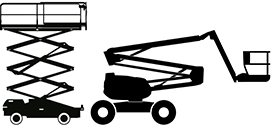
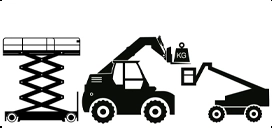
Category 1b: mast lifts, scissor lifts and similar vertical machines on wheels (drivable from the basket)
-
Category 3a: vehicle-mounted and articulating platforms (articulating boom) – not self-propelled from the basket
-
Category 3b: self-propelled telescopic and articulating boom lifts (drivable from the basket)
Anyone who has completed only 1b training may not operate a telescopic boom lift with an articulating arm. This is a common error on construction sites that leads to an immediate operating stop during checks.
Validity and refresher
The PAL Card is valid for 5 years. Before expiry, a refresher course must be completed – otherwise the authorisation lapses automatically. Important: the refresher generally only covers the practical part; anyone who waits too long may have to repeat the complete basic training.
Why machine-specific instruction remains mandatory despite the PAL Card
The PAL Card proves basic knowledge. It does not, however, replace machine-specific instruction on the specific rental machine. Every work platform differs in control logic, emergency-lowering system, safety circuits and load limits. An operator who has worked with JLG machines for years does not yet automatically know the operating philosophy of a Haulotte or Genie.
In accordance with BetrSichV and DGUV Regel 308-008, the rental company is obliged to document this machine-specific instruction – and the entrepreneur is obliged to demand it. Luibl Rental carries out this instruction at equipment handover and provides the corresponding protocol.
System Card and national certificates compared
In addition to the IPAF PAL Card, national training systems exist, including the System Card programme, which is offered in Germany by various professional associations and training institutions. In terms of content, the System Card is comparable to the PAL Card: theory, practice, category-based authorisation.
The essential difference lies in international recognition: the PAL Card is accepted in over 60 countries and is often a prerequisite on large construction sites of multinational companies. The System Card is primarily established in the German-speaking region.
Luibl Rental accepts both proofs – the decisive factor is that the category matches the planned equipment use and that the certificate is valid.
Written appointment – the employer's duty
DGUV Regel 308-008 requires a written appointment by the employer. This is not bureaucratic formalism, but the documented confirmation that:
-
the employee is qualified for the specific machine
-
they have been instructed about the risk assessment at the place of use
-
the employer has checked their suitability
If this document is missing, the operator is not legally authorised – even if they can present a valid PAL Card.
Practical example: safety management on the large construction site
A façade construction company from Lower Bavaria rents three telescopic work platforms (category 3b) from Luibl Rental for a renovation in Passau's old town. Project duration: seven weeks, three operators in alternating operation.
The problem: subcontractors also work on the construction site. It is unclear who may operate which machine – and whether all operators are qualified for telescopic boom lifts.
The solution with Luibl Rental:
Before the equipment is handed over, all PAL Cards and System Cards of the nominated operators are checked. Category, validity and equipment suitability are documented. Subsequently, an on-site instruction takes place for all three machines – separately per operator, since each platform, despite the same category, has different control logics.
In addition, the operators are instructed on the correct fitting of PPE against falls (PPEaF): with telescopic boom lifts, wearing a fall-arrest harness with an anchor point in the basket is mandatory. The harnesses are not co-rented – the entrepreneur must provide them. Luibl Rental points this out if this aspect was not yet taken into account with the enquiry.
The result: two weeks later, the construction site passes an unannounced check by the responsible employers' liability insurance association without objection.
UVV inspection and PPE against falls (PPEaF)
Machine-side safety: the UVV inspection sticker
Every work platform in Luibl Rental's fleet has a valid UVV inspection sticker on delivery. The accident-prevention regulation DGUV Vorschrift 68 (formerly BGV D27) prescribes annual inspections by an expert. For long-term rental contracts, the UVV inspection is included – no contracting party has to worry about deadline management.
In addition to the annual inspection, Luibl Rental carries out a function check before every delivery: emergency lowering, tilt switch, end-position limits, load-protection systems. The associated inspection protocols are at the machine at handover.
Person-side safety: PPEaF for boom lifts
With work platforms with a slewing or telescoping boom – specifically with articulating boom lifts, articulating telescopic boom lifts and truck-mounted work platforms – wearing PPEaF (personal protective equipment against falls) in accordance with DGUV Regel 112-198 is prescribed. Reason: in the event of a sudden system stop, the operator can be thrown out of the basket by the oscillation impulse.
What this means in practice:
-
Fall-arrest harness (EN 361) + connecting means with fall absorber (EN 355) or self-locking guided-type fall arrester
-
Anchor point in the basket – not on the guardrail, but at the intended fixing point (observe manufacturer specification)
-
No use of work-positioning belts (EN 358) as fall protection – these do not stop a free fall
With scissor lifts, PPEaF is not generally prescribed according to DGUV Regel 308-008, but can be determined within the framework of the operator's risk assessment – for example when working over water or at great hall heights.
Renting with legal certainty at Luibl Rental
Rental responsibility does not end with the signature on the rental contract. Anyone who uses a work platform assumes, as an entrepreneur, an operator's duty – with direct consequences in the event of failures.
The three pillars of legally compliant operation:
-
Proof of training: valid PAL Card or System Card with the matching equipment category – for every operator who operates the machine
-
Written appointment: the employer confirms the qualification and grants the formal permission to operate the equipment
-
Machine-specific instruction: carried out and documented at handover by Luibl Rental – mandatory in accordance with BetrSichV §12 and DGUV Regel 308-008
Luibl Rental offers certified training to IPAF standard as well as for the System Card at its locations. Anyone who cannot yet present valid proof at the start of the rental should raise this early – ideally with the enquiry, so that the training date and equipment provision can be coordinated.
Questions about operator certificates, training options or the legal prerequisites for your specific deployment case are answered by the Luibl Rental team during service hours Mon–Fri, 08:00–17:00.
Rental conditions, UVV and availability
Daily rental, weekly rental, long-term rental: daily rentals for 10-tonne models start at around 200 euros net; weekly and monthly rates are proportionally significantly cheaper. For long-term rental from six months, Luibl calculates individual project prices including UVV inspection, annual maintenance and in some cases also a fuelling service.
UVV inspection: every forklift in the Luibl fleet leaves the hub with a valid inspection sticker in accordance with DGUV Vorschrift 68 (industrial trucks) and DGUV Grundsatz 308-001. For long-term rental, Luibl takes over the annual repeat inspection during the rental period.
Operator training: DGUV Vorschrift 68 requires a written appointment and proven competence of the driving personnel. Luibl offers operator training for heavy-duty forklifts on request – including the specific hazard situation caused by load-centre displacement and residual load capacity.
Response times and service: in the event of technical faults during the rental period, Luibl provides a service technician directly on site on request. For industrial customers with critical operational processes, framework contracts with defined response times can be negotiated.
FAQ: frequently asked questions about the operator certificate and safety obligations
Is a driving licence required for self-propelled work platforms?
For self-propelled work platforms (scissor lifts, telescopic boom lifts) on closed construction sites and private premises, no motor-vehicle driving licence is necessary. For truck-mounted work platforms the following applies: up to 3.5 t total weight, class B; above that, class C1 or C.
Is instruction by the company sufficient instead of IPAF training?
Formally, company instruction in accordance with BetrSichV §12 is sufficient, provided the employer can prove the qualification. In practice, the IPAF certificate or the System Card is the recognised standard, as it is accepted by employers' liability insurance associations and construction-site checks.
How far in advance must I book a training date at Luibl Rental?
Please raise this directly with your rental enquiry. Training capacities are limited, especially for training with several participants.
Does my PAL Card apply to all platform types in the Luibl fleet?
No. Each category only entitles you to the corresponding equipment types. Category 1b applies to scissor lifts and mast lifts; category 3b to self-propelled telescopic and articulating boom lifts. With the equipment enquiry, Luibl Rental indicates which category is required for the desired model.
What happens if an operator without a valid certificate is found on a Luibl rental platform?
This is exclusively a matter for the renting company. As the rental company, Luibl Rental is not liable for the deployment of unqualified personnel. The entrepreneur, as the operator, bears full responsibility – with possible consequences through fines, an operating ban and civil liability in the event of damage.