Renewable energy boom 2026: which height-access technology for wind power, PV and biomass?
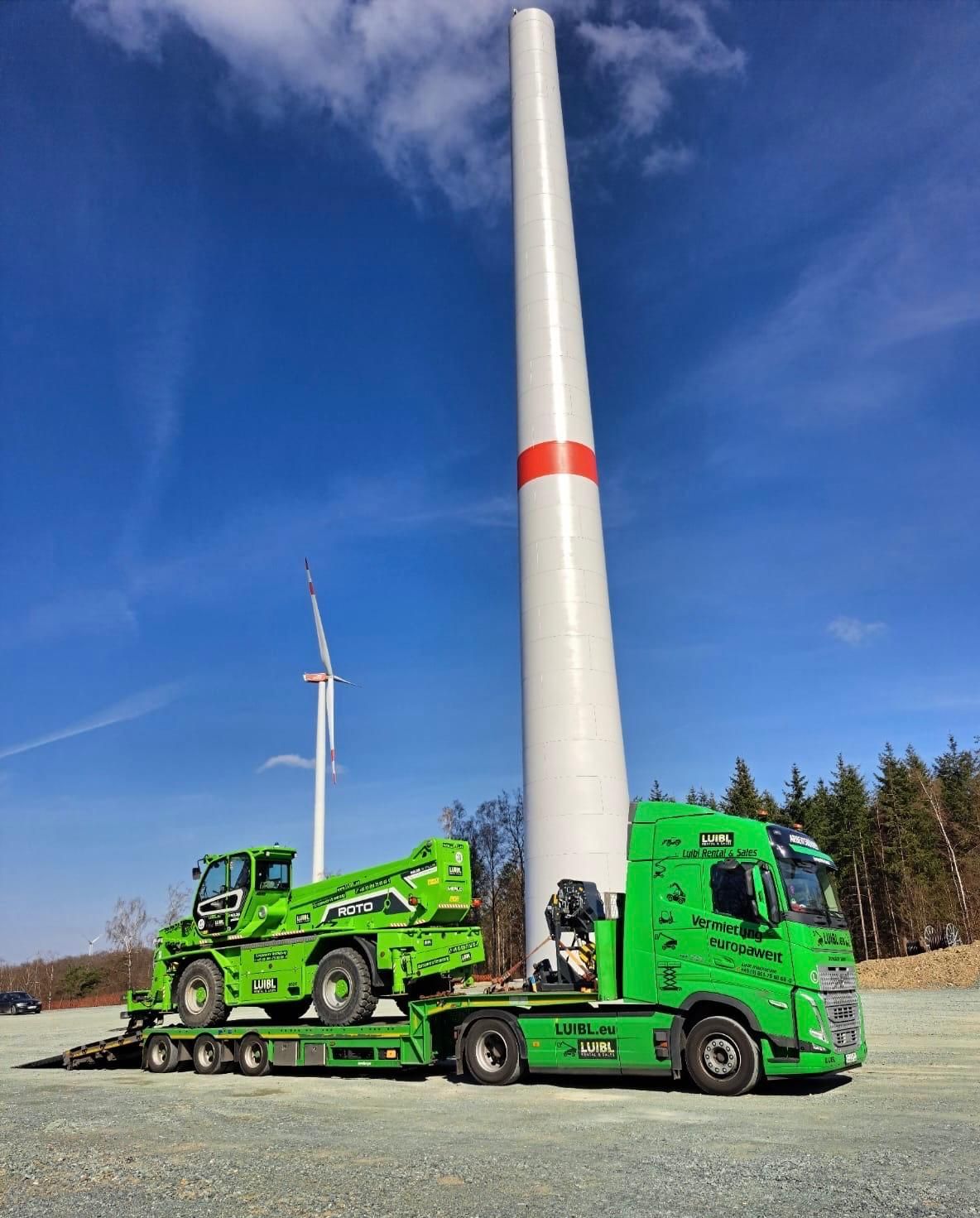
In 2026, over 60 percent of German electricity comes from renewable sources. Wind power and photovoltaics are growing at record pace – and with them the need for installation, maintenance and inspection. All of this requires one basic prerequisite: safe access at height. But which technology is the right choice for which plant type?
Record year 2026 – renewable energy on a growth course
The figures from the Federal Network Agency (Bundesnetzagentur) speak a clear language: in 2025 alone, 17.7 GW of photovoltaics and 5.3 GW of wind power were newly installed in Germany. In 2026, the share of renewable energy in public net electricity exceeds the 60 percent mark. The EEG 2026 (German Renewable Energy Sources Act) continues the expansion incentives – with adjusted subsidy rates and new regulations for negative exchange prices.
What is often lost in the political debate: behind every kilowatt-hour lies installation work at height. Every wind turbine must be maintained regularly. Every roof subject to the solar obligation needs a safe access solution. And every biogas plant must be inspected. The demand for professional height-access technology grows with the expansion of renewable energy – directly and proportionally.
Wind power: height access up to 240 metres
Wind turbines place the most demanding requirements on height-access technology. Modern onshore turbines reach hub heights of 160 metres and more; rotor blades reach up to 240 metres. Here, specialised solutions are needed.
Work platforms and lifting platforms for tower work
For maintenance work on the tower – renewing coatings, repairing damage, checking cable systems – high-performance work platforms with reaches of over 100 metres are used. Truck-mounted telescopic boom lifts enable fast access to defined working areas without elaborate climbing equipment. They are particularly efficient when several turbines in a wind farm are worked on one after another.
Rope-access technique for rotor blades
For the inspection and repair of rotor blades, the rope-access technique (RAT) is the standard. Trained industrial climbers with IRATA or FISAT certification work rope-guided along the blades, which are up to 80 metres long. They can detect cracks, erosion damage and lightning-protection defects and repair them directly on site – without a crane, without scaffolding, with minimal time expenditure.
Rotor-blade access systems as a special solution
For systematic inspections of larger wind farms, operators increasingly rely on special rotor-blade access systems. These move mechanically guided along the blade surface and enable structured documentation. In addition, drones are used for external inspection – classic height-access technology remains indispensable, however, as soon as repairs are necessary.
Photovoltaics: roof and open space – two different worlds
PV installation is divided into two fundamentally different deployment scenarios, each with its own requirements for access technology.
Work platforms for roof and façade installation
On pitched roofs and façades, the same regulations apply as for any other roof work: collective protection takes precedence, leaning ladders are prohibited as a workplace. Electric articulating boom lifts and trailer platforms offer fast, locally emission-free access – ideal for individual objects and smaller projects without elaborate scaffolding erection.
Spider lifts for open-space systems
Solar parks on open spaces pose different challenges: the terrain is often uneven, access is restricted, and the modules are close to the ground but nevertheless in an area that is difficult for regular vehicles to access. Spider lifts with low ground pressure and high off-road capability are the first choice here – they move safely between the module rows and lift fitters safely to working height.
Telehandlers and crawler cranes for heavy components
During the initial installation of larger open-space systems, heavy inverters, transformer containers and support frames have to be positioned precisely. Telehandlers and crawler cranes handle the large components, while work platforms ensure the installation support service.
Biomass: inspection and maintenance at height
Biogas plants, wood-fired heating plants and biomass power plants are less visible than wind and solar installations – their maintenance requirement, however, is just as real. Boiler systems, chimney flues, silos and fermenter tanks must be inspected and maintained regularly.
Depending on the plant size, work platforms, mobile scaffolds or rope-access techniques are used. With silos and fermenters, internal inspections are often unavoidable – here specialised equipment is needed that does justice to both confined spaces and fall risks. Industrial climbers with experience in confined spaces are indispensable for such assignments.
Comparison: which access technology for which plant type?
| Plant type | Typical height | Recommended access solution |
|---|---|---|
| Wind power tower | 80–160 m | Truck-mounted work platform, tower-internal lifts |
| Wind power rotor blade | up to 240 m | Rope-access technique (IRATA/FISAT) |
| PV pitched roof | 5–15 m | Scaffolding, trailer platform |
| PV flat roof | 5–20 m | Scissor lift, edge protection |
| PV open-space system | 2–5 m | Spider lift, telehandler |
| Biomass silo / fermenter | 10–30 m | Work platform, confined-space RAT |
| Biomass chimney / boiler | 10–50 m | Scaffolding, rope-access technique |
Qualification and safety: what height workers must bring with them
Regardless of the plant type, clear legal requirements apply to all work at height:
-
Collective protection before individual protection – scaffolding, work platform or edge protection take precedence over PPE
-
Risk assessment is mandatory before work begins
-
Qualification: FISAT Level 1–3, IRATA, SCC Doc 17/18, DVS 2220 – depending on the area of use
-
DIN EN 13374 governs temporary edge-protection systems (classes A–C)
-
BG BAU and BGHM provide guidelines and practical aids for all types of energy plant
For wind turbines, the following also applies: operators are responsible for the safety of all persons who enter or climb their installations – including external companies and maintenance service providers.
One contact for all plant types
The energy transition creates work – on the roof, on the tower, in the solar park and at the biogas plant. Anyone who, as an operator or service provider, wants to be professionally positioned needs access to the right height-access solutions for every deployment case.
Whether a spider lift for the open-space park, a telescopic boom lift for the wind tower or the rope-access technique for the rotor blade – the choice of the right access technology determines the efficiency, safety and profitability of every project.
Get advice now: our experts find the right access solution for your plant – whether wind, solar or biomass.
FAQ – frequently asked questions about height-access technology for renewable energy
Which height-access technology is most frequently used for wind turbines?
For tower work up to approx. 100 m, truck-mounted work platforms or tower-integrated lifts are standard. For rotor blades, the rope-access technique (RAT) in accordance with IRATA or FISAT is the widespread method – it enables work at 200+ metres height without heavy equipment.
Do you need a lifting platform for open-space solar parks?
Not necessarily for every task, but for the initial installation and regular maintenance, spider lifts are the most efficient solution. They are off-road capable, have low ground pressure and manage without paved access routes.
What does deploying a work platform for solar systems cost?
Trailer platforms from approx. €100 / day, truck-mounted work platforms from €250 / day, spider lifts from €300 / day – each excluding transport costs. For a PV maintenance project with 1–2 days of deployment, costs of €300–1,500 are realistic.
Which certificates do industrial climbers need for wind turbines?
At least FISAT Level 1 or IRATA Level 1, supplemented by GWO certification (Global Wind Organisation) for offshore assignments. For specific work, SCC Doc 17/18, DVS 2220 and OPITO certificates are added.
Is the rope-access technique safer than work platforms?
Both methods are safe when applied correctly. RAT is more flexible on hard-to-access structures, while work platforms offer a more stable workplace. The risk assessment determines which method is permissible and sensible for the respective assignment.
What impact does the EEG 2026 have on the demand for maintenance services?
Due to the sharply increased number of installed plants (in 2025 alone: 17.7 GW PV, 5.3 GW wind), the maintenance backlog is growing. Plants from the boom years 2020–2025 are now entering the care cycle – this means massively rising demand for maintenance and inspection services up to 2030.