Luibl GmbH offers efficient gas-powered forklifts for rent. Optimize your warehouse processes. Request now and get started successfully!
Rent Gas Forklifts – The Powerful Hybrid Solution for Warehouse and Yard
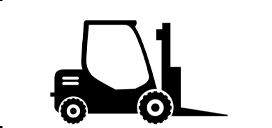
Diesel forklifts are unbeatable outdoors, electric forklifts indoors. If you need both in a single machine – with no charging cycles, no range anxiety, and no second vehicle standing by – the gas-powered forklift is the answer. At Luibl Rental you can hire LPG (liquid petroleum gas) forklifts with load capacities from 1.8 to 7 tonnes and lift heights of over 6 metres. Swapping the gas bottle takes less than two minutes and brings the machine straight back to full operation – the decisive advantage in multi-shift operations.
Your gas forklift rental fleet at Luibl at a glance:
-
Load capacity 1,800 kg to 7,000 kg
-
Lift heights 5.04 m to 6.03 m
-
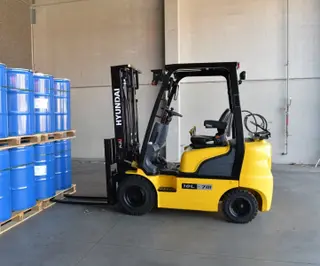
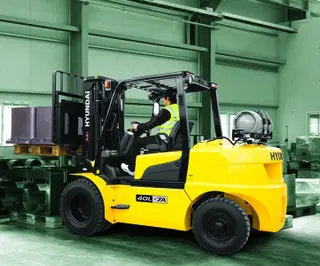
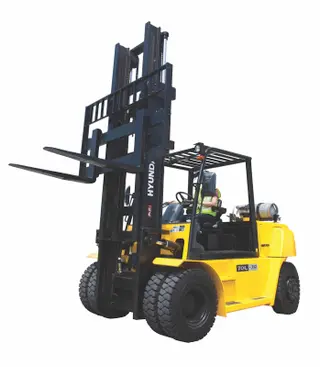
Models: Hyundai 18L-7M, 40L-7A, 70L-7A
-
Three-way catalytic converter and LPG combustion – suitable for indoor use provided ventilation is adequate
-
Safety inspection under the German Ordinance on Industrial Safety and Health (BetrSichV) and DGUV Regulation 68, plus annual LPG system inspection under DGUV Regulation 79
-
Europe-wide delivery on our own low-loader trucks
The Advantages of Renting LPG Forklifts from Luibl
A gas forklift is not a compromise solution – it is the technically correct answer to a specific usage profile. Three strengths make the difference:
-
Fast readiness with no charging cycle. Swapping the gas bottle takes under two minutes. No breaks, no second forklift standing by as a stopgap, no charging infrastructure needed on site. In three-shift operations, this is the decisive productivity lever.
-
Warehouse and yard with a single machine. Thanks to LPG combustion and a three-way catalytic converter, emissions stay low enough for use in ventilated warehouses – while retaining full power outdoors in the yard. One forklift covers both zones.
-
High power density at moderate weight. For an equivalent load capacity, a gas forklift is often lighter than its electric counterpart with a heavy battery – reducing ground pressure and enabling use on more sensitive surfaces.
Applications – When Is a Gas Forklift the Best Choice?
Beverage and Food Industry
Beverage wholesalers, breweries, food logistics: goods are constantly moved between warehouse, loading ramp and yard – often in multi-shift operation, often at high throughput. In one project for a beverage wholesaler, gas forklifts noticeably reduced downtime compared with the charging cycles of electric forklifts, thanks to the quick bottle swap. The decisive factor: no unproductive charging break in the middle of peak demand.
Production Facilities with Mixed Working Zones
If goods intake happens outdoors but production and order picking take place in the warehouse, you need a machine that handles both zones without compromise. Gas forklifts meet this profile with no need to switch drive types and no loss of performance. Typical industries: automotive suppliers, packaging, and timber/furniture production.
Intensive Multi-Shift Operations Without Charging Infrastructure
Seasonal peaks, extra shifts, project work on temporary sites: when there is no powerful charging infrastructure on site, or simply no time for charging cycles, LPG is the reliable solution. Luibl also delivers at short notice for campaign deployments lasting anywhere from a few weeks to long-term rentals spanning several months.
Event Logistics and Trade Show Assembly
Trade show assembly, open-air events, indoor events: flexible zones, changing loads, often no permanent electrical infrastructure. The gas forklift goes into operation with no preparation and stays mobile.
Technical Details of Our LPG Rental Forklifts
Load Capacities from 1.8 to 7 Tonnes
Three load-capacity classes cover the broad range of applications:
-
1.8 tonnes (Hyundai 18L-7M) – 5.04 m lift height. Compact class for pallet handling, beverage trade, specialist retail.
-
4 tonnes (Hyundai 40L-7A) – 6.03 m lift height. Mid-range for industrial handling, heavy containers, wholesale.
-
7 tonnes (Hyundai 70L-7A) – 5.06 m lift height. Top class for machinery-industry suppliers, timber industry, steel trading.
Mast Types – Standard, Duplex and Triplex
The right mast depends on warehouse door height, ceiling height and the required final lift height:
-
Standard mast for regular operations with no clearance restrictions
-
Duplex mast two-stage, compact overall height, standard for many warehouses
-
Triplex mast three-stage with initial free lift – mandatory for container unloading, truck loading under low doors, or work on mezzanine floors
Application tip: the initial free lift determines whether you can raise the load without the mast extending upward. This is critical at container loading doors or where clearance height is restricted.
Attachments – Factory-Fitted or on Request
Available as standard:
-
Side shifter – for precise pallet positioning
-
Fork positioner – hydraulic, for different pallet widths with no manual repositioning
Configurable on request:
-
Fork extensions for longer loads
-
Rotating attachments (e.g. paper roll tippers, waste container emptiers)
-
Full cab with heating and air conditioning
-
Operator canopy with windscreen and wiper
Individual configuration is especially worthwhile for long-term rentals – we tailor the equipment to your specific application profile.
Technology – Three-Way Catalytic Converter and LPG Combustion
Gas forklifts burn liquid petroleum gas (LPG, usually a propane-butane mix) in a spark-ignition engine. The three-way catalytic converter reduces carbon monoxide, unburned hydrocarbons and nitrogen oxides to a level that permits indoor use – provided the workplace is adequately ventilated (in line with the requirements of the German trade association (Berufsgenossenschaft) and the Workplace Ordinance (ArbStaettV)). Modern rental units meet the current emissions standards for their respective engine class. We provide details on the specific model in the data sheet on request.
Safety and Inspections – DGUV Regulation 79 in Focus
Handling LPG gas cylinders is clearly regulated in Germany. Luibl ensures that every rental unit meets the requirements:
-
Annual LPG system inspection under DGUV Regulation 79 carried out by qualified experts. Documentation is provided with every rental unit.
-
Safety inspection under the German Ordinance on Industrial Safety and Health (BetrSichV) and DGUV Regulation 68 (UVV) with a current inspection sticker
-
Secure cylinder mounting with certified fastening and shut-off device
-
Operator instruction provided by the hirer on handling the gas cylinder – on request we also offer the corresponding training
Operator qualification: Operation is governed by DGUV Principle 308-001 – written authorisation, medical fitness (G25) and theoretical/practical instruction, the classic "forklift operator's license" (Staplerschein). Handling the gas cylinders themselves additionally requires instruction under TRBS 3151 (protection against hazards from liquefied petroleum gas).
FAQ – Everything About Gas Forklift Hire

Which is cheaper to hire: electric or gas?
How does gas supply work for hired equipment?
How long does a gas cylinder last during hire operation?
Are gas forklifts suitable for rough terrain?
What equipment is included as standard?
What happens if the equipment breaks down during the hire period?
How is the forklift delivered?
May you operate an LPG forklift indoors?
A Straightforward Rental Process at Luibl
Four steps to a ready-to-use gas forklift:
-
Request – via contact form, by phone on +49 (0) 851 756868-0, or by e-mail. Tell us the location, rental period, load, and whether the application is indoors, outdoors, or mixed.
-
Consultation and quote – we select the right model (1.8 t, 4 t or 7 t), recommend suitable equipment, and send you the quote at short notice.
-
Delivery by low-loader – on schedule from the nearest Luibl location. Delivered fully assembled with cylinder mounting and UVV-inspected.
-
Operation and service – on-site briefing available on request. Our service technicians remain available throughout the rental period.
Request a Gas Forklift Rental Quote Now
You have the application – we have the right machine in our rental fleet.
→ Go to the request form → Call us directly: +49 (0) 851 756868-0