
Rent Telescopic Boom Lifts in Graz – Maximum Outreach for Industrial Construction
Telescopic boom lifts cover the upper performance range of access equipment: a straight boom, maximum outreach and working heights from 22 to 57 metres make them the first choice for warehouse and industrial construction, facade work on large open sites, and infrastructure maintenance. The price for this is weight – and with it the requirements for ground load-bearing capacity, transport logistics and precise advance planning using the outreach chart.
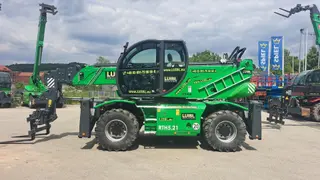
Luibl hires out diesel telescopic boom lifts from Genie, JLG and RTJ, with direct low-loader delivery to Graz and Styria. The range spans working heights from 22 to 57 metres; all machines are fitted with four-wheel drive and an oscillating axle, and are handed over with current inspection documentation and the manufacturer's load chart.
Powerful Telescopic Boom Lifts for Graz and Styria
The choice of machine depends primarily on three parameters: the required working height, the outreach under full load, and the basket capacity with simultaneous occupancy of people and tool weight. Since outreach and basket capacity affect one another – higher loading reduces the permitted outreach via the load moment limiter – the outreach chart for the chosen model must be checked against the specific project requirements before submitting a rental enquiry.
Diesel telescopic boom lifts with four-wheel drive for rough terrain
The Luibl rental fleet includes diesel telescopic boom lifts in the following performance classes:
-
JLG 660SJ (22 m working height): Entry-level model for facade work and warehouse assembly up to the second level of an industrial hall. Load capacity 227 kg, diesel, 360° basket rotation. Easy to transport; suitable for construction sites in Styria where no low-loader permit for oversized loads is required.
-
JLG 1200SJP (approx. 38 m working height): Four-wheel-drive system, Tier 4 engine, basket space for up to 3 people. Distinctive feature: full extension in under 95 seconds – relevant on sites with tight time windows (e.g. shift operation during ongoing hall use). Scenario around Graz: fitting sandwich panels to an approximately 35 m high warehouse facade in a Graz industrial estate. The basket capacity allows panel-fixing tools and two fitters to be carried at the same time. In wind gusts, which can occur even in summer in the hilly Styrian countryside, the rigid telescopic boom shows no bending resonance – unlike articulating boom lifts with multiple joints. At wind speeds from 12.5 m/s (45 km/h), the load moment limiter engages and blocks lifting movement in accordance with OENORM EN 280.
-
Genie SX-135XC / JLG 1350SJP (43 m working height each): Two technically comparable large machines with different manufacturer philosophies. The SX-135XC (Genie, 450 kg load capacity) features automatic work-envelope monitoring, a chassis tilt sensor with zero-load calibration, and the Mini Genie X-Chassis for variable wheelbase – retracted for transport, extended for maximum stability on site. The JLG 1350SJP (450 kg) combines four-wheel drive with four-wheel steering and an active oscillating axle: four-wheel crab steering allows lateral movement parallel to the facade without cornering – a decisive productivity factor on confined Graz industrial sites with a fixed lane width. Both models: 45% gradeability, extendable axles for quick set-up, basket space for 3 people.
-
Genie SX-150 (48 m working height): Load capacity 340 kg, outreach 24.38 m, X-Chassis, 135° basket rotation. Application: bridge maintenance and cable routing under elevated rail lines in the Graz area, where high outreach combined with a small footprint is required.
-
Genie SX-180 (57 m working height): The flagship model in Luibl's telescopic boom lift portfolio. Working height 56.9 m, outreach 24.4 m, load capacity 340 kg, X-Chassis, self-levelling 2.44 m platform. The 3.05 m basket arm rotates 135° vertically and 60° horizontally – relevant for work on structures requiring a precise lateral angle to the boom. Infrastructure scenario: during the inspection of motorway bridge beams in the greater Graz area, the active oscillating axle allows safe positioning on a sloping strip of ground beneath the carriageway. The chassis tilt sensor only releases the lifting function once the standing surface is within the permitted tilt tolerances – so the nominal basket capacity of 340 kg for tools and operating personnel is fully available. On uneven ground exceeding this tolerance, levelling with bedding plates or preliminary bulldozer work is required.
Electric and hybrid telescopic boom lifts for locally emission-free large projects
Pure electric telescopic boom lifts in the class from 20 metres working height upward are not listed as a separate category in Luibl's current portfolio – the locally emission-free alternative for indoor halls and inner-city Graz sites with environmental restrictions is covered by electric articulating boom lifts (up to 28 m) and bi-energy models running in electric mode. For projects with this requirement, a direct enquiry is recommended so that Luibl can recommend the technically appropriate machine from the full portfolio.
Avoid planning mistakes on your construction site. Send us the specifications of your project in Graz, and our technicians will check the right load chart for you. Get a no-obligation quote now: https://www.luibl.eu/en/contact/
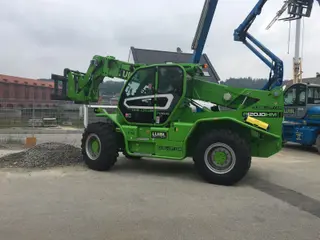
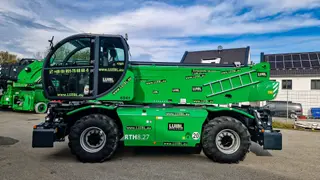
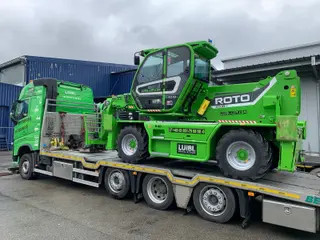
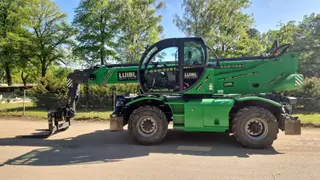
Technical Parameters: Focus on Working Height, Outreach and Basket Load
A common planning problem: site managers choose the telescopic boom lift based on the nominal working height – and then find on site that the load moment limiter shuts off the lifting function, for the specific combination of outreach and basket weight, before the target position is reached.
The reason: the telescopic boom is a lever arm. The further it is extended and the heavier the basket load, the greater the tipping moment at the base. The built-in load moment limiter continuously compares the current moment against the permitted limit from the load chart – and automatically blocks the corresponding movement direction if it is exceeded. In concrete terms, this means:
-
A machine with a nominal basket capacity of 450 kg can only use this full load at low outreach (close to vertical).
-
At maximum outreach, the permitted basket capacity is significantly lower – typically around 230 kg on machines with a dual-capacity function.
-
For Graz projects with two fitters (combined body weight of approximately 160–180 kg) plus tools and materials (50–100 kg), a realistic basket load of 210–280 kg results – which limits full outreach on mid-range telescopic boom lifts.
Luibl provides the manufacturer-specific outreach chart with every rented telescopic boom lift. It shows the permitted outreach as a function of working height and basket load – the essential basis for planning, to avoid surprises on site.
A second parameter often underestimated on Graz construction sites is the ground pressure under the drive wheels with the arm fully extended. On compacted gravel or asphalt, this is generally not critical. On construction ground with residual moisture, on grassland, or on ground with limited load-bearing capacity – typical of sloped terrain in the hilly Styrian countryside – the point load must be calculated and distributed using steel plates or bedding plates. The machine data sheets contain the vehicle-specific ground pressure values, which Luibl provides in advance on request.
Styria Logistics Concept: Heavy-Load Transport Direct to Your Site
Telescopic boom lifts in the class above 40 metres working height require heavy-load transports that cannot be handled with a standard low-loader. Oversized width, excess weight and official exemption permits for journeys within the Graz city area are not the exception for large machines such as the Genie SX-150 or SX-180, but the standard process.
Luibl operates its own low-loader fleet designed for these requirements:
-
Permit handling: For oversized transports in the greater Graz area, Luibl coordinates the required route permits. Planning lead times and official processing periods must be factored into delivery scheduling – an early rental enquiry is recommended.
-
Variable axle width (X-Chassis): Genie models with X-Chassis™ travel on the road with retracted axle width – this reduces the transport width to standard dimensions and considerably simplifies the permit situation compared with machines with a fixed maximum width.
-
Direct delivery route Passau–Graz: Journey time approximately 3 hours with no intermediate stop at subcontractors. Scheduled delivery within a defined window, coordinated with the start of your project.
-
Collection after project completion: Return by Luibl low-loader directly from the site; a condition report is checked against at handover.
Occupational Safety and Statutory Inspection Requirements under Austrian Law
Telescopic boom lifts in the 38–57 metre class are subject in Austria to strict regulations that bind both the hire company and the on-site operator:
AM-VO § 8 (Work Equipment Ordinance): Every aerial work platform must undergo recurring inspection by competent persons; the inspection log (physical or digital) must be available on or with the machine at every handover. Luibl supplies the current inspection documentation with every machine – as evidence for your operating records and for any checks by site supervision on your Graz construction site.
OENORM EN 280: This standard defines requirements for stability verification, wind-load calculation and the function of integrated load-monitoring devices. Relevant for use in Styria: as a rule, the operating limit is set at wind speeds of 12.5 m/s (45 km/h) – given gusts that frequently occur in the hilly Styrian countryside in autumn, an anemometer on site is advisable. If the limiting wind speed is exceeded, operation must stop and the platform brought into transport position.
Operator qualification: The AM-VO requires the operator to entrust operation only to personnel with demonstrable training. The internationally recognised PAL Card (IPAF) is regarded in practice as accepted documentation – many Styrian industrial customers explicitly require it. Luibl offers machine-type-specific training on request.
Machine breakdown insurance: Luibl offers, on request, cover against technical faults through no fault of the hirer and unforeseeable material damage during the rental period. The excess and covered claims are transparently defined in the rental agreement – no surprises later at final settlement.
Secure the right access equipment for your project period. Request your individual rental quote here, including the calculated transport charge for the greater Graz area: https://www.luibl.eu/en/contact/
