Rent aerial work platforms and construction machinery in Kriens
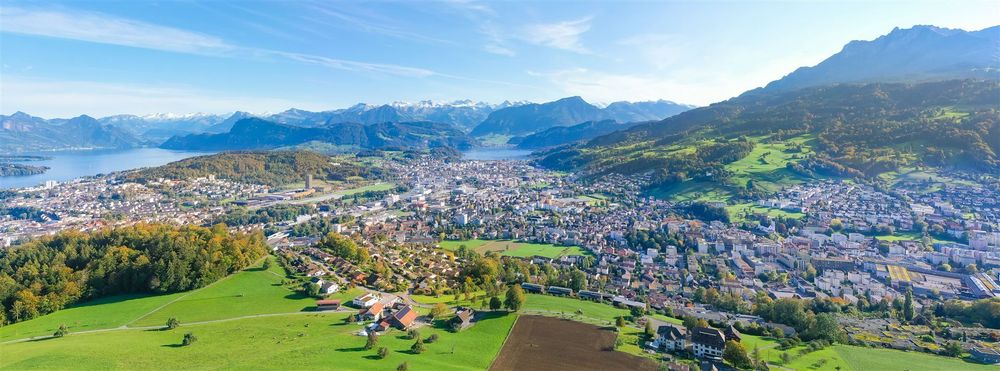
Renting aerial work platforms and construction machinery in Kriens means thinking about the ground first and about working height only afterwards. The municipality runs from the valley floor up to the foot of Pilatus: dense built-up areas with commercial premises and residential tower blocks below, hillside districts above, connected by narrow, winding access roads. Between these two worlds lie gradients, retaining walls, embankments and approaches on which a machine cannot simply be parked. We supply inspected mobile elevating work platforms, telehandlers, excavators and forklifts, and clarify before delivery how the machine will reach the place of work, how it will stand there and what gradient the set-up area permits.
Setting up on a slope: gradient limits and a load-bearing stand
Every mobile elevating work platform has a limit for the permissible gradient in the raised position, laid down in the operating manual — it is not exceeded, not even with packing underneath. In practice that means either the set-up area is made level, or the machine brings a levelling capability of its own via its outriggers. For hillside locations, spider lifts with 13.00 to 39.50 m working height are therefore the typical choice: tracked undercarriage instead of wheels, low ground pressure on embankments and gravel beds, four individually adjustable outriggers with which the machine is brought level on sloping ground. On surfaced but inclined approaches, articulating boom lifts with outriggers are an option, provided the standing area can take the outrigger loads.
The route there is just as critical. Hillside roads in Kriens are narrow, have turning heads instead of through traffic and in places weight restrictions; above the carriageway there are often retaining walls whose backfill is not designed for heavy axle loads. Where an articulated lorry cannot get through, we unload at the nearest suitable point and move the machine up the gradient under its own power — tracked machines cope with considerably more incline than wheeled ones. Distance from the edge of the embankment, load spreader plates and clearance of the area by the site management are a precondition in all of these cases, not an extra.
Residential tower blocks and cable car technology: plenty of height, little standing area
Above the valley floor stand several residential tower blocks whose facades, balcony parapets, roof edges and rooftop plant are maintained regularly. The set-up area in front of them is usually tight: forecourt, green space, underground car park ramp, visitor parking. What counts here is the ratio of working height to footprint. Telescopic boom lifts cover 14.00 to 56.90 m and therefore also reach the upper storeys when the machine has to keep its distance from the building because of a structure underneath. For work at changing positions along one side of a facade, articulating boom lifts are more practical, because the platform can be repositioned without moving the machine.
The installations on the local mountain bring a task of their own: towers, deflection points, station roofs and access walkways stand away from surfaced paths, in places on steep terrain, and are only accessible during maintenance windows. Spider lifts get further there than any wheeled machine. For installation work involving heavy components, mini cranes complete the picture, because they reach the spot along narrow paths and place loads there for which a platform is not designed. Indoors — in station and plant rooms — mast lifts with 10.00 to 12.65 m and 200 kg platform capacity are usually sufficient.
The rental fleet in numbers
| Class | Working height | Platform capacity |
|---|---|---|
| Scissor lifts, electric | 6.30 – 33.00 m | 227 – 1,000 kg |
| Scissor lifts, diesel | 9.70 – 34.00 m | 363 – 1,134 kg |
| High-rack scissor lifts | 18.50 – 33.00 m | 450 – 1,000 kg |
| Articulating boom lifts | 10.89 – 48.15 m | 150 – 450 kg |
| Telescopic boom lifts | 14.00 – 56.90 m | 227 – 454 kg |
| Mast lifts | 10.00 – 12.65 m | 200 kg |
| Spider lifts | 13.00 – 39.50 m | 200 – 400 kg |
Earthworks, lifting gear and materials handling on the slope
On a slope, more is moved than lifted. Excavators from 1.8 to 30 t operating weight take on excavation, slope stabilisation, service lines and the adaptation of access routes; in confined hillside districts the requirement is usually at the lower end of the weight range, because access and turning space limit the size. Telehandlers set material down across changes in level without a crane having to be erected — rigid machines with 4.30 to 18.80 m lift height and 1.25 to 25 t, roto models with 15.42 to 38.90 m and 4 to 8 t where several levels are to be served from a single set-up. In the commercial premises on the valley floor, forklifts from 3 to 16 t handle the transfer of goods; for unsurfaced areas there are rough-terrain forklifts.
Safety law: who answers for what on steep terrain
For assignments in Kriens, the Ordinance on the Prevention of Accidents and Occupational Diseases (VUV) applies, implemented and supervised by SUVA and made specific by the directives of the Federal Coordination Commission for Occupational Safety (EKAS); the framework is the Labour Act and its associated ordinances. The recurring inspection of mobile elevating work platforms follows SN EN 280. From us come the inspection certificate, CE documentation and operating manual; the operating manual also states the permissible gradient and the outrigger loads, which on a slope decide whether a set-up area can be released. Assessment of the terrain — stability, distance from the embankment, risk of falling and slipping, securing against material rolling away — and the instruction of the operator remain with the hirer, as does the visual and functional check before work begins.
Transport to Kriens
We travel to central Switzerland with our own low-loaders from Passau and agree the date and unloading point in advance. For Kriens, three pieces of information are decisive: the gradient and width of the access route, the available turning space and the condition of the set-up area. If there is a weight or width restriction on the hillside road, we plan the unloading point on the valley floor and move the machine up under its own power. For assignments at installations away from the road, we discuss beforehand whether an access route has to be prepared. Anyone looking after properties in the wider urban area at the same time can combine the date with assignments in Lucerne.
Frequently Asked Questions
How much gradient can an aerial work platform take when being set up?
The permissible gradient is stated for each machine in the operating manual and is not exceeded — it is a design limit, not a recommendation. In practice the stand is either made level or compensated for by the outriggers. Spider lifts have individually adjustable outriggers for this and manage considerably more travel gradient than wheeled machines. Tell us the measured gradient at the set-up area and we will check which models are suitable.
What happens if the low-loader cannot use the hillside road?
Then we unload at the nearest suitable point and the machine covers the distance itself. This requires a continuously passable route of sufficient width with a load-bearing surface. We need details of the gradient, narrow points and any weight restrictions in advance. Where access is very difficult, a site visit before delivery is worthwhile.
Which platform reaches the top storey of a residential tower block?
That depends on the distance the machine has to keep from the facade. If an underground car park, a green area or a forecourt lies in between, the height of the building quickly turns into a considerably greater reach requirement. Our telescopic boom lifts cover 14.00 to 56.90 m working height, articulating boom lifts 10.89 to 48.15 m with additional lateral movement. The eaves height and the distance from the standing position are enough for us to work out the specification.
May we set up on outriggers directly next to a retaining wall or the edge of an embankment?
Only with sufficient clearance and after approval. The backfill behind a retaining wall often cannot take point outrigger loads, and at the edge of an embankment there is a risk of slipping. We provide the outrigger loads of the machine so that the site management or a structural engineer can assess the area. Load spreader plates are the rule on sloping ground.
Are spider lifts suitable for work on meadows and forest tracks?
Yes, that is what they are built for. The tracked undercarriage spreads the weight over a large area, so that soft and unsurfaced ground suffers less than it would under wheel loads. Working heights of 13.00 to 39.50 m with 200 to 400 kg platform capacity cover tree care, line and plant work. On waterlogged ground we nevertheless recommend walking the route beforehand.
Working height, outreach and ground conditions determine the right machine. A comparison of all designs with costs and inspection duties is available at Rent a lifting platform: platform types, costs and applications.