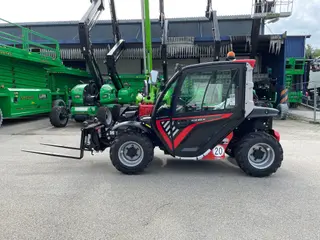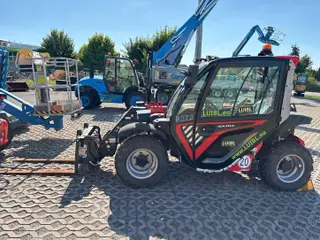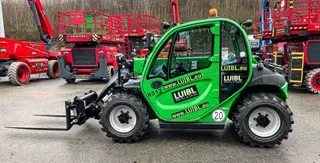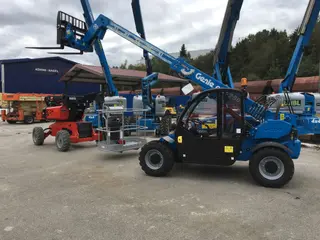
Manitou MHT 12330
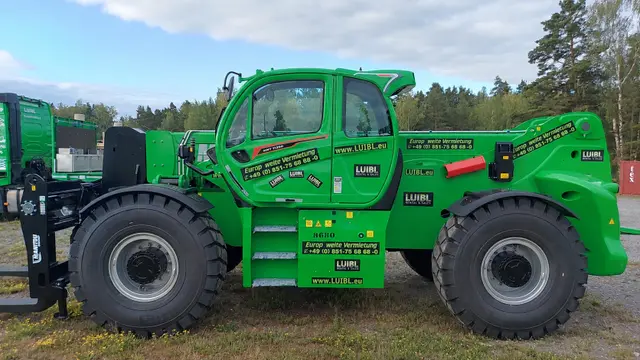
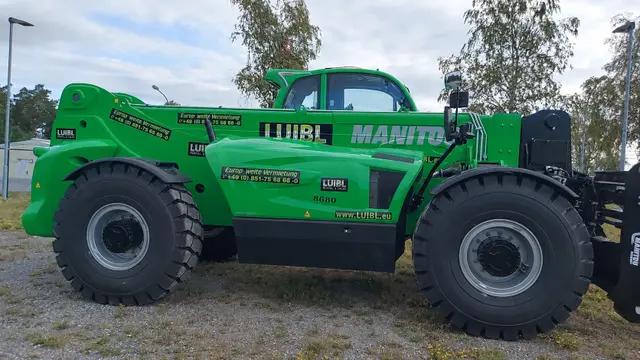
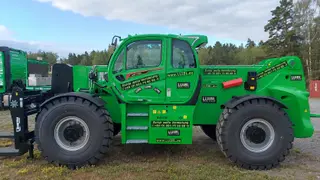
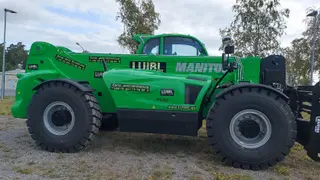
Manitou MHT 12330 hire – heavy-duty telehandler with 33 tonnes lifting capacity
For lifting operations beyond the 20-tonne limit, project managers in mining, power plant construction and heavy cargo handling often have only two options to choose from: truck crane or mobile crane. Both require extensive crane set-up times, dedicated crane operators, clearance areas and a ground slab infrastructure that is not available at many sites. The Manitou MHT 12330 adds a third option to this range: 33,000 kg rated capacity at a 1,200 mm load centre, 6.6 m maximum reach and 12,000 kg residual load at full horizontal outreach. The maximum lift height is 11.92 m. Luibl Rental coordinates delivery and logistics for this machine weighing approx. 49 tonnes – including heavy haulage planning.
For heavy lifting tasks
With the MHT 12330, large stone or marble blocks can be moved in quarries, long objects such as steel bars, rails or metal structures can be handled, and mining equipment can be serviced: changing wheels, replacing cylinders and erecting conveyor systems. The difference from a mobile crane lies in the operating radius: the MHT 12330 can travel under full load. It sets down a load, drives to the next placement point and lifts the next component – without dismantling, relocating the crane position or setting up again. For projects with many individual lifts along a route – for example when erecting conveyor belt supports in open-cast mining or assembling wind turbine components – this capability considerably reduces the total cycle time per lift.
The MHT 12330 has an unladen weight of approx. 49,000 kg. This value is relevant for project planning on several levels: for calculating the ground bearing capacity at the site and for selecting the means of transport. On request, Luibl Rental takes over complete transport coordination and provides all relevant machine data.
Drive and hydraulics: 180 kW output
The MHT 12330 is powered by a 245 hp Deutz engine. The hydrostatic transmission with three forward and three reverse gears enables infinitely variable speed control between creep speed under full load and transport travel. The maximum travel speed is 25 km/h – sufficient for on-site relocation on large construction sites and mining areas.
The JSM joystick combines travel direction, boom telescoping, lifting function and attachment control in a single control element. With a load of 33,000 kg being guided over several metres of boom to an installation point, one-handed operation is not a comfort feature but a safety requirement: the operator keeps a hand on the joystick and eyes on the load and can intervene immediately if necessary – without changing grip and without reaction delay from switching controls.
The variable displacement pump delivers a hydraulic flow of 310 l/min at 350 bar. The load-sensing control continuously adapts pressure and flow to current demand. During simultaneous movements – lifting while telescoping or travelling – the flow-sharing system prioritises the hydraulic supply to the active cylinders as required, without individual functions dropping out due to pressure loss.
Safety at the extreme: E-Reco and stability control
The E-Reco system automatically detects when an attachment is correctly fitted and assigns the corresponding load chart to the system. With 33-tonne loads, this function has direct safety relevance: the load chart of a crane hook attachment differs considerably from that of a fork carriage. An incorrect load chart – possible with manual input – would calibrate the load moment limiter on the basis of incorrect limit values. The E-Reco system rules out this operating error by design, as attachment recognition is chip-based and automatic.
The load moment limiter monitors the current load moment in real time and prevents the permissible value from being exceeded by automatically limiting movements – regardless of the operator's reaction.
The cab is certified to ROPS and FOPS Level 2. The noise level in the operator's station is 80 dB(A), hand-arm vibration is below 2.50 m/s². For long-shift operation in mining or on wind power projects with assembly times of several days, these values are operationally relevant.
Applications: mining, steel construction and wind energy
Open-cast mining and quarrying: large stone and marble blocks as well as heavy components for servicing mining equipment – wheels, cylinders, conveyor sections – are handled without crane set-up and without ground reinforcement for crane outriggers. All-wheel drive with three steering modes – road, four-wheel and crab steering – ensures mobility on unpaved mining terrain.
Heavy industrial plant assembly: reactor vessels, transformers and press components with individual weights between 20 and 33 t are lifted into their installation position. The ability to travel under load allows the machine to be moved between closely adjacent assembly points in the time a crane needs for re-rigging.
Wind power logistics: nacelles, rotor hubs and heavy machine frames of onshore wind turbines regularly exceed the 25-tonne limit on modern installations. The MHT 12330 positions these components in their assembly position using a crane hook attachment. The optional 3-hook jib also allows components with an eccentric load centre to be picked up.
Port and heavy cargo handling: fork tines in lengths from 1.80 m to 3.65 m allow two containers to be picked up at the same time, enabling standardised heavy cargo containers to be handled in a single lift. The 21.00 R35 tyres distribute the machine weight on port surfaces designed for heavy-duty operation.
Cost efficiency: why hire the MHT 12330 instead of using cranes?
A truck crane in the 100-tonne class needs between half a working day and a full working day for set-up, outrigging and stability calculation, depending on the site. The MHT 12330 rolls off the low loader, the operator receives a briefing and the first load is picked up. This difference in set-up time is the decisive cost factor for projects with many individual lifts or frequently changing work locations within a major construction project.
Luibl Rental organises delivery of the MHT 12330 by heavy-duty low loader. The machine is handed over serviced and inspected. The original Manitou data sheet including the load chart and the E-Reco attachment list is supplied with every handover.
Frequently asked questions about the Manitou MHT 12330
What is the maximum lifting capacity of the Manitou MHT 12330?
The rated capacity is 33,000 kg at a 1,200 mm load centre. At the maximum reach of 6.6 m, 12,000 kg is still available. At maximum lift height it is 20,000 kg. Luibl Rental provides the complete load chart with all intermediate values at handover.
Which engine does the MHT 12330 use?
A 245 hp Deutz engine powers the MHT 12330. Exhaust aftertreatment works with AdBlue.
How is the MHT 12330 delivered?
The unladen weight of approx. 49,000 kg requires a heavy-duty low loader. Luibl Rental coordinates transport planning and vehicle deployment. Customers receive a complete transport overview with a schedule in advance.
Which attachments are compatible?
Fork tines in various lengths, crane hook mount, cable winch, personnel basket, bucket, tyre handler, cylinder holders and the optional 3-hook jib. The E-Reco system automatically detects every compatible attachment and adjusts the load chart without operator intervention. Luibl Rental clarifies the availability of attachments on request.
Hire the Manitou MHT 12330 from Luibl Rental across Europe now
Luibl Rental organises delivery and transport of the MHT 12330 by arrangement – including heavy haulage coordination and on-site briefing. On request, technical support from qualified technicians is available throughout the entire rental period.
Request availability and rental terms now.
Send enquiry
Key technical data
- Lift height: 11.92 m
- Lifting capacity: 33,000 kg
- Lateral reach: 6.6 m
- Width: 2.98 m
- Height: 3.6 m