Cable Winch Attachment for Telehandlers
Rent a Telehandler Bucket
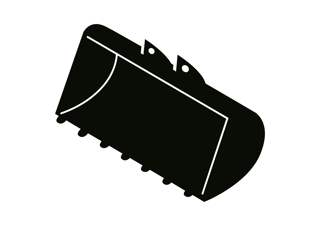
A telehandler transforms into a fully capable loading machine when equipped with a bucket. Instead of undergoing complex retooling or sourcing a separate wheel loader, a quick-hitch system allows for a simple attachment swap—enabling the telehandler to handle earthmoving, bulk material, and general material handling directly on the job site. Luibl rents telehandler buckets with Europe-wide delivery and rapid availability.
Overview of Bucket Types
Not every bucket is suitable for every application. Key factors include the material to be handled, the required volume, and compatibility with the specific telehandler model in use.
Earth bucket (toothless) – Volume approx. 0.5 to 2.0 m³. Used for grading and leveling slopes, creating smooth surfaces, and uniform excavation work.
Earth bucket (with teeth) – Volume approx. 0.9 m³. Designed for harder soils, trenching, and foundation work. The teeth allow for deeper penetration into compacted material.
Light-material bucket – Volume approx. 1.2 m³ and up. Designed for free-flowing bulk materials with low specific weight, such as grain, mulch, broken glass, wood chips, and compost. The larger volume economically compensates for the material's low density.
Grapple bucket (4-in-1) – A multi-purpose attachment for leveling, grabbing, sorting, and material handling. The hydraulically opening bucket lip makes it a versatile tool for handling various materials on the construction site. Areas of Application
Telehandler buckets are used wherever bulk materials need to be moved or earthworks carried out:
Building and Civil Engineering: Excavating trenches and foundations, backfilling, and grading
Construction Site Logistics: Handling sand, gravel, and crushed stone directly from trucks
Landscaping and Gardening: Transporting and spreading mulch, bark mulch, and topsoil
Agriculture and Warehousing: Loading grain, silage, and bulk materials using light-material buckets
Recycling and Waste Management: Handling construction debris, broken glass, and other free-flowing waste materials
Compatibility and Quick-Coupler System
Telehandler buckets are mounted using the host machine's quick-coupler system. Compatibility depends on the specific telehandler model's mounting system. Luibl provides advice on selecting the right attachment—tailored to the rented telehandler and the specific application. You can find all other available attachments in the overview of telehandler attachments.
Why Rent a Telehandler Bucket Instead of Buying?
Purchasing a bucket attachment is rarely cost-effective for project-specific use. Renting offers immediate availability without tying up capital, maintenance-free use, and the flexibility to choose the right bucket type for the job. Luibl supplies buckets and telehandlers as a complete package—customized to the required quantity, rental period, and location.
FAQ: Renting a Telehandler Bucket
Which bucket fits my telehandler? This depends on the mounting system—specifically, the telehandler's quick-coupler type. Luibl provides personalized advice to ensure the host machine and attachment are compatible.
Can I rent the bucket and telehandler together? Yes. Luibl rents out telehandlers and compatible attachments as a complete package. Submit inquiries via the contact form or by phone.
What materials is the light-material bucket suitable for? The light-material bucket is designed for free-flowing materials with low specific weight, such as grain, mulch, wood chips, compost, and broken glass. For heavy excavated material like sand, gravel, or soil, the earth bucket is the right choice.
How quickly is the attachment available? Luibl delivers telehandlers and attachments throughout Europe. Availability and delivery dates are confirmed during the inquiry process.
What driving license do I need for a telehandler with a bucket? No license is required for telehandlers with a design speed of up to 20 km/h; for road travel, a Class L or B license is required depending on the weight. Luibl also offers training courses for telehandler operators.
Inquire about a telehandler bucket now – Luibl provides prompt advice and delivers across Europe.
Rent a winch for telehandlers
Equipping a telehandler with a hydraulic winch attachment transforms it into a mobile crane alternative. Suspended loads can not only be lifted but also lowered in a controlled manner and positioned with vertical precision—capabilities not possible with pallet forks or standard load hooks alone. Luibl rents out hydraulic winches for telehandlers, offering Europe-wide delivery via its own fleet of low-loader trucks.
How does the telehandler winch work?
The hydraulic winch mounts to the telehandler’s boom head using a quick-change system. It is powered by the carrier machine’s hydraulic system, requiring no separate power supply or external power units. The winch enables the safe winding and unwinding of the cable under load. The operator controls winch operations directly from the cab; on suitably equipped models, remote control operation is also possible.
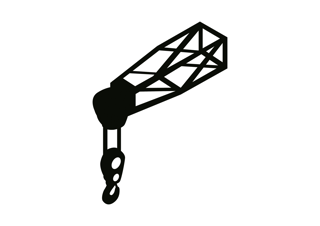
Unlike a lattice boom winch, a standard winch mounts directly to the boom head without an additional lattice boom extension. This limits horizontal outreach but allows for higher load capacities of up to 6 tonnes.
Technical specifications
Load capacity: 3 to 6 t, depending on model and carrier machine
Drive: Hydraulic, powered by the carrier machine
Cable length: Up to approx. 49 m, depending on model
Controls: From the cab; remote control available on selected models
Compatibility: Primarily for rotating telehandlers (Roto); specific models also suitable for rigid-frame telehandlers
Mounting: Via hydraulic quick-change system, operated directly from the cab
Safety: Dual braking system featuring a hydraulic brake and a negative safety brake
Winch vs. lattice boom winch – which attachment to choose? Winch load capacity: up to 6 t
Lattice jib winch load capacity: 800 to 2,000 kg
Winch horizontal reach: no
Lattice jib winch horizontal reach: yes (over obstacles)
Winch cable length: up to approx. 49 m
Lattice jib winch cable length: approx. 3 m
Winch application: vertical lifting and lowering
Lattice jib winch application: reaching over roofs, shafts, and obstacles
Winch compatibility: rotating telehandlers and—depending on the model—rigid telehandlers
Lattice jib winch compatibility: rotating telehandlers only
The winch (without a jib) is the ideal choice for heavy loads requiring vertical lifting or precise lowering—such as into shafts or basements. The lattice jib winch is better suited for placing a load horizontally over an obstacle. Areas of Application
Building and industrial construction: Lifting steel beams, precast concrete parts, and heavy machinery without a mobile crane
Assembly work: Precisely lowering pumps, power units, and pipes into shafts and basements
Steel construction: Positioning steel structures and beams during the construction of halls and bridges
Infrastructure: Installing pipelines, sewer components, and foundation elements
Logistics: Unloading bulky, suspended loads that cannot be safely handled with pallet forks
Crane alternative without an external crane operator
For lifting tasks up to 6 tonnes that do not justify a permanently stationed mobile crane, the rotating telehandler with a cable winch offers a more economical and flexible alternative: The machine is all-terrain capable, available at any time, and operated by existing, suitably qualified site personnel. Lead times, permits, and crane operator costs are eliminated. Operating the cable winch requires additional "Level 2a" qualification in accordance with DGUV 308-008; Luibl can provide information on certified training partners upon request.
You can find an overview of all available attachments under "Telehandler Attachments."
FAQ: Renting a telehandler with a cable winch
Which telehandlers are suitable for the cable winch? Primarily rotating telehandlers. Certain models with a hydraulic connection at the boom head can also be operated as rigid-frame telehandlers with a cable winch. Luibl will clarify compatibility during the inquiry process.
What is the difference between a cable winch and a lattice boom winch? The winch is mounted directly on the boom head and offers a lifting capacity of up to 6 t with a long cable length of approximately 49 m. The lattice boom winch complements a lattice boom and enables horizontal reaching over obstacles, though it has a significantly lower lifting capacity of 800 to 2,000 kg.
What qualifications do I need to operate the winch? Crane operations involving a winch require additional Level 2a qualification in accordance with DGUV 308-008. Luibl can recommend suitable training partners upon request.