Telehandler licence under DGUV 308-009: levels, costs, duration
Short answer: who needs the telehandler licence?
Every person who operates a telehandler in operational use — regardless of whether the machine is bought or rented. The employer may only assign persons who have proven their competence in accordance with DGUV Principle 308-009, are at least 18 years old and are physically and mentally suitable.
This guide neutrally explains which levels exist, what the qualification typically costs and how long it takes with external, recognised providers, and how it differs from the forklift licence and the road driving licence. Luibl does not offer training itself — we rent out the machines and tell you what matters when it comes to qualification.
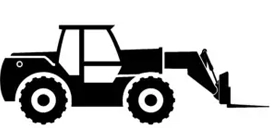
Which type requires which qualification level is shown in the overview in the telehandler guide.
Legal basis: DGUV Principle 308-009
DGUV Principle 308-009 governs the qualification and assignment of drivers of all-terrain telescopic forklifts. It is the counterpart to DGUV Principle 308-001 for industrial trucks — the classic forklift licence.
Important: the forklift licence does not automatically cover the telehandler. Anyone who drives both machine types needs both qualifications; however, existing prior knowledge often shortens the training.
The levels at a glance
Level 1: fixed telehandlers
Basic qualification for telehandlers without a rotating superstructure: lifting, stacking and transporting with standard attachments. It is the basis for all further levels.
Level 2a: rotating telehandlers and crane operation
Extension for roto telehandlers with a 360° superstructure as well as for use with a cable winch or load hook as a crane replacement. In addition, outriggers, load charts in crane mode and basic knowledge of lifting accessories are covered.
Level 2b: transporting people with a work basket
Additional qualification for lifting people in the work basket on the telehandler. Here DGUV Principle 308-008 also applies, as the machine is operated as a mobile elevating work platform in this configuration.
Costs and duration of the qualification
Training takes place with external, recognised providers — educational institutions, inspection organisations and manufacturer-affiliated academies. As a guide from the market, depending on provider, region and prior knowledge:
| Qualification | Typical duration | Typical cost range |
|---|---|---|
| Level 1 (fixed) | 1–2 days | approx. €250–450 |
| Level 2a (rotating, winch), follow-on | 1–2 days | approx. €300–500 |
| Level 2b (transporting people), follow-on | 0.5–1 day | approx. €150–350 |
| Combined courses Level 1 + 2a/2b | 2–3 days | approx. €500–800 |
Guide values of external providers, as of 09/2026. Binding prices and dates are provided by the respective training provider.
With an existing forklift licence or construction machinery experience, many providers shorten the training. On request, Luibl names recognised providers in your region. The enquiry is made via the page Training.
Prerequisites
- Minimum age of 18
- Physical and mental suitability; occupational health check-ups according to the risk assessment
- Theoretical and practical training with an examination at the recognised provider
- Subsequently, the written assignment by the employer — without it, the machine may not be driven even with a certificate
Telehandler licence, forklift licence and driving licence — the distinction
| Telehandler licence | Forklift licence | Driving licence | |
|---|---|---|---|
| Legal basis | DGUV Principle 308-009 | DGUV Principle 308-001 | FeV |
| Applies to | Telehandlers (fixed and roto) | Industrial trucks, forklifts | Driving on public roads |
| Covers telehandlers? | yes | no | no |
Which driving licence class is required for road journeys — including the 40 km/h special case — is explained in the guide Telehandler driving licence.
Rent the right telehandler with the right qualification
The level determines the choice of machine: with Level 1 you rent fixed telehandlers, with Level 2a the roto telehandler including winch, with Level 2b additionally the work basket.
During the enquiry process, Luibl checks that machine and qualification match, and delivers throughout Europe — including a machine-specific briefing at handover.
Course of the training: theory, practice, examination
The qualification follows the same basic pattern with all recognised providers.
Theory. Legal basics and operator obligations, design and function of the machine, stability and load charts, attachments, behaviour in the event of faults, dealing with power lines and traffic routes.
Practice. Daily operational check, picking up and setting down loads, working with telescopic extension and outriggers, tight driving manoeuvres, with Level 2a additionally slewing the superstructure and crane operation with a winch, with Level 2b operation with a work basket.
Examination. Theoretical part in writing, practical part on the machine. After passing the examination, the participant receives the certificate; the employer then issues the assignment.
Group sizes in the practical part are limited because each person has to drive the machine — this is why dates often have to be planned well in advance.
Validity, refresher training and record keeping
The certificate in accordance with DGUV Principle 308-009 has no legally defined expiry date. That does not mean that it lasts indefinitely:
- The annual instruction of employees is mandatory anyway and also covers machine-specific topics.
- Many companies schedule refresher training every two to three years, particularly in the case of infrequent use or after near misses.
- If the machine type changes — for example from a fixed telehandler to a roto — the appropriate level must be completed; an instruction is not sufficient.
For documentation: the certificate, assignment and instruction records belong in the personnel file or in the occupational safety documentation and must be able to be presented in the event of an incident. For rental machines, this obligation remains entirely with the company using the machine — the rental company provides the inspected machine and gives a machine-specific briefing.
Employer obligations at a glance
Anyone who uses telehandlers — their own or rented — bears these obligations:
| Obligation | Legal anchor | Practical implementation |
|---|---|---|
| Risk assessment | ArbSchG, BetrSichV | before use, job-related |
| Qualification of the operator | DGUV Principle 308-009 | external, recognised provider |
| Written assignment | DGUV Regulation 1 | by name, with machine type |
| Annual instruction | ArbSchG, DGUV Regulation 1 | documented |
| Inspection of the machine | BetrSichV | qualified person, inspection log |
| Rescue concept for basket operation | DGUV Principle 308-008 | emergency lowering practised, second person |
This list is the reason why the question "Who may drive?" is rarely answered in one sentence: the certificate is necessary, but not sufficient on its own.
What a missing qualification costs
The €250 to 800 for training seems like a cost item — it is more like an insurance premium. Three calculations on this:
Insurance cover. Machinery breakdown and liability reduction agreements practically always exclude damage caused by unqualified operating personnel. A damaged telescopic boom or damage to the load quickly reaches the five-figure range — and then remains entirely with the company.
Regulatory law. If it is established during an inspection or after an accident that the machine was driven without a certificate or without a written assignment, fines and the decommissioning of the machine are threatened. In the case of personal injury, the personal responsibility of the manager is also at stake.
Downtime. The most expensive item is rarely the damage itself, but the idle construction site: organising a replacement machine, rescheduling transport, replanning trades.
This is offset by one to three days of training, which also teaches the safe use of load charts and outriggers — exactly the points where most damage occurs. The machines for this are available for rent: Rent a telehandler.
Frequently asked questions
How much does the telehandler licence cost?
With external, recognised providers, depending on level and prior knowledge, around €250–800 (guide range, as of 09/2026). Binding prices are provided by the respective provider.
How long does telehandler operator training take?
Level 1 typically 1–2 days, combined courses up to Level 2a/2b a total of 2–3 days — depending on provider and prior knowledge.
Is the forklift licence sufficient for the telehandler?
No. The forklift licence in accordance with DGUV Principle 308-001 applies to industrial trucks; for telehandlers, a separate qualification in accordance with DGUV Principle 308-009 is required. Prior knowledge often shortens the training.
What is the difference between Level 2a and 2b?
Level 2a qualifies for rotating telehandlers and crane operation with a winch; Level 2b additionally for transporting people in the work basket in accordance with DGUV Principle 308-008.
Who offers the qualification in accordance with DGUV 308-009?
Recognised external providers such as educational institutions, inspection organisations and manufacturer-affiliated academies. Luibl does not offer training itself, but on request names recognised providers in your region.