Telehandlers: Types, Load Capacity, Obligations and Rental at a Glance
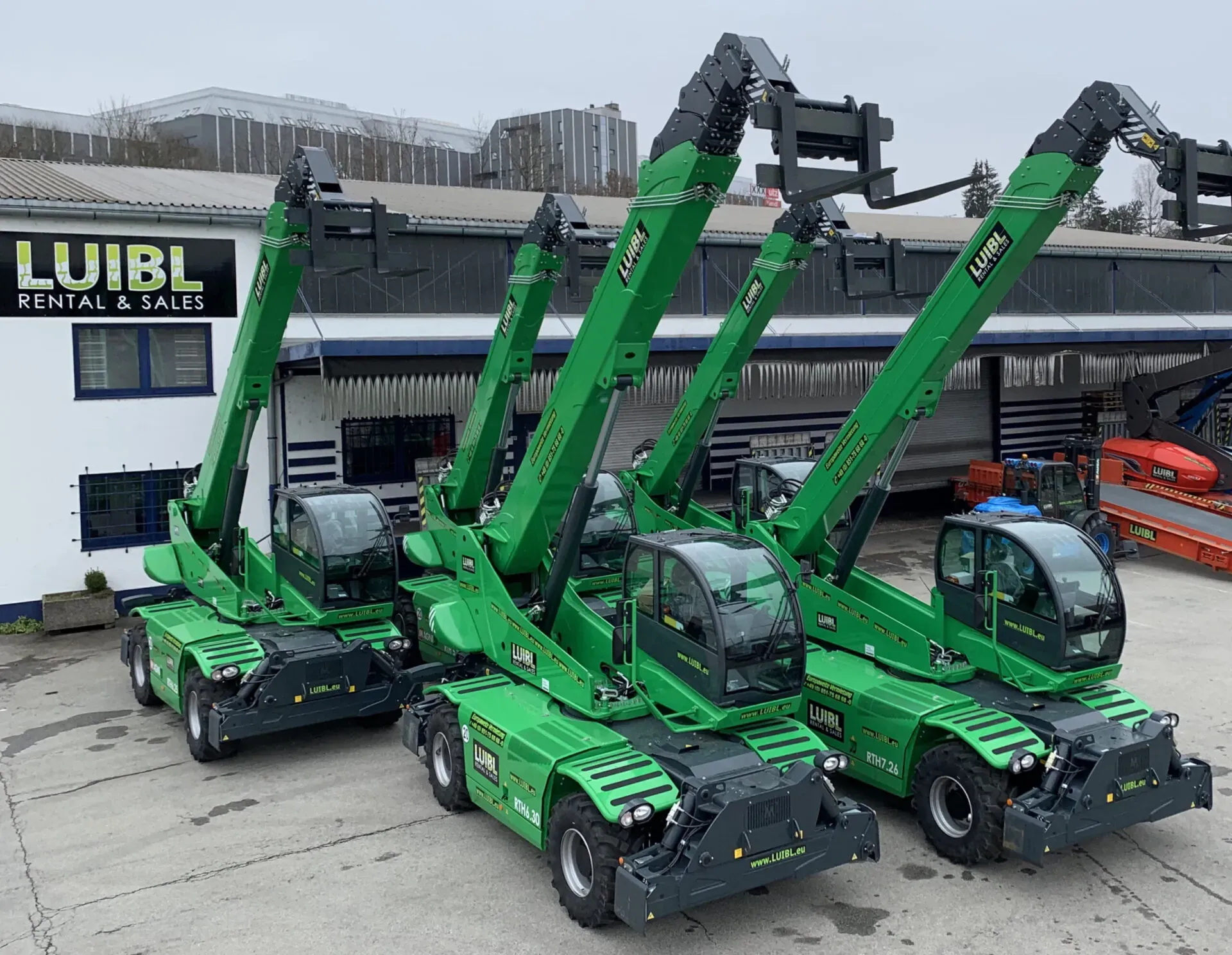
Short answer: telehandlers lift up to 25 t and up to 38.9 m high
A telehandler is an all-terrain lifting machine with an extending telescopic boom. It lifts, stacks and places loads where a forklift can no longer reach and a crane would be too much effort. In the Luibl rental fleet, the machines range from 4.30 m to 38.90 m lift height and from 1.25 t to 25 t lifting capacity.
This makes it a standard machine on construction sites, in agriculture and in industry. The difficulty lies in the selection: which type fits, how much load capacity remains at full outreach, and which qualification does the operator need? This guide answers these questions at a glance and refers you to the relevant in-depth article for each detailed question.
Three telehandler types cover different tasks
Telehandlers differ mainly in whether the superstructure rotates and how they are powered. The figures are taken from the current Luibl rental fleet:
| Type | Lift height | Lifting capacity | Typical use |
|---|---|---|---|
| Fixed | 4.30 – 18.80 m | 1.25 – 25 t | Loading material, stacking pallets, moving bulk material |
| Roto (rotating) | 15.42 – 38.90 m | 4 – 8 t | Roof installation, crane replacement, working over obstacles |
| Electric | 5.85 – 30.00 m | 2.5 – 7 t | Halls, city centres, noise-sensitive areas |
Fixed telehandlers are the all-rounders. The boom only works forwards, and the machine travels with the load (pick-and-carry). For particularly heavy loads there are dedicated Heavy-Duty Telehandlers.
Roto telehandlers have a superstructure that rotates through 360° and are set up on outriggers. They work in all directions from a fixed position and, with a winch or load hook, replace a mobile crane in many cases.
Electric telehandlers run on batteries and are locally emission-free in operation. They are suitable for halls and jobs with noise protection requirements. What matters inside buildings is explained in the guide Telehandlers in halls.
Attachments turn the telehandler into a multi-purpose machine
Via the quick coupler, a telehandler takes various attachments. Each attachment changes its function:
- Pallet forks: lifting and stacking, the standard for building materials and pallets
- Bucket: loading and moving bulk material such as sand, gravel or harvested crops
- Winch and load hook: lifting freely suspended loads, with the roto as a crane replacement
- Work basket: raising people to height, the machine then works like an aerial work platform
Each attachment has its own load chart. The lifting capacity of the base machine therefore does not automatically apply to the winch or work basket. For crane operation and transporting people, the operator also needs an extended qualification (see below).
Telehandlers in use: construction, agriculture and industry
Telehandlers are used wherever loads have to be lifted, reached forwards and moved over rough ground at the same time:
- Building and industrial construction: distributing material over several storeys, placing precast concrete elements and roof trusses, facade and roof work with a work basket
- Agriculture: stacking bales, handling feed and bulk material, filling silos, usually with compact fixed models and a bucket
- Logistics and industry: loading and unloading on unpaved surfaces, handling bulky goods, maintenance work at height
This is made possible by four-wheel drive, four-wheel steering with crab steering for sideways movement and coarse-tread tyres. As a result, the telehandler remains operational even on unpaved construction sites where forklifts and many aerial work platforms can no longer drive.
Four criteria decide which telehandler is right
The maximum values in the brochure are not enough for the selection. What counts is what the machine has to achieve at the specific site:
- Load capacity at outreach. With every metre of outreach, the permissible load decreases. A 4 t telehandler often lifts only a fraction of that with the boom fully extended. The decisive point in the load chart is where the load is set down.
- Lift height and reach. Height alone is not enough. How far forwards the load has to go, for example over a canopy or a trench, is just as important.
- Space and ground. Where the machine cannot manoeuvre, the roto saves repositioning. Soft ground, slopes and outrigger bearing areas determine whether and how safely the machine can be supported.
- Drive and environment. In halls and city centres there is a lot to be said for electric, on rough terrain for diesel with four-wheel drive.
The guide Fixed or roto compares both systems in detail. An overview of the manufacturers is provided by the brand comparison Magni, Manitou, Merlo.
Telehandler, crane or aerial work platform: the task decides
A telehandler only partly replaces other machines. Drawing the line saves rental costs:
- Compared with the forklift, the telehandler has the advantage on rough terrain and at height. On level hall floors with many lifting cycles, a forklift usually works more economically.
- Compared with the crane, the roto scores with short set-up time and multiple uses. For very great heights, reaches or single loads, the crane remains the right choice.
- Compared with the aerial work platform, the telehandler with a basket pays off if material is also lifted during the same job. For pure work at height, an aerial work platform is more flexible and usually cheaper.
How telehandlers and wheel loaders differ when handling bulk material is explained in the practical comparison.
Operating a telehandler: qualification under DGUV 308-009 and annual inspection
Using a telehandler involves obligations for the person and for the machine.
The operator needs a qualification in accordance with DGUV Principle 308-009, usually called a "telehandler licence", and a written assignment from the employer. The qualification is divided into levels: Level 1 applies to fixed machines, Level 2a to roto and crane operation, Level 2b to transporting people in the work basket. A forklift licence is not enough. Details on levels, duration and costs can be found in the guide Telehandler licence.
On public roads a driving licence is also required. Depending on speed and weight, these are classes L, T or C1/C. Which class applies when is explained in the guide Telehandler driving licence.
The machine must be inspected by a qualified person at least once a year in accordance with DGUV regulations and the Ordinance on Industrial Safety and Health (BetrSichV) (UVV inspection). Before each use, the operator also checks it for defects. Luibl rental machines are handed over with a valid inspection, together with a machine-specific briefing. This briefing does not replace the qualification.
Renting a telehandler: fixed models from around €150 per day
For most companies, renting is more economical than buying, because the machine is chosen to suit each project. Guide values net, excluding transport and attachments, as of 09/2026:
| Machine class | Day | Week |
|---|---|---|
| Fixed, up to 19 m lift height | €150 – 280 | €600 – 1,200 |
| Roto, 15 – 39 m lift height | €350 – 650 | €1,400 – 2,700 |
Transport, attachments and fuel are added. With weekly and monthly rental, the daily rate drops significantly. All price factors and three calculation examples can be found in the guide Renting a telehandler: costs.
Luibl delivers from our Passau location with its own low-loaders directly to the site, throughout Europe and via a network of more than 200 locations. With early scheduling, the right machine can be reliably planned in. If you need a machine at short notice, we will promptly clarify availability.
Checklist: seven details for a suitable telehandler quote
The more precise the enquiry, the better the machine fits and the fewer surprises there are on the invoice. These details help with the selection:
- Heaviest load and its weight: for example a pallet of roof tiles, a steel beam or a big bag
- Set-down height and outreach: how high and how far from the machine position is the load set down?
- Attachments: forks, bucket, winch, load hook or work basket
- Site: rough terrain, paved surface or hall, plus access width and clearance height
- Ground: load-bearing, soft or sloping, and where outriggers can be set up
- Period: start and expected duration, as weekly and monthly rentals are cheaper
- Qualification: which level under DGUV 308-009 the operators hold
If a detail is missing, the machine is easily chosen too large or too small. That costs an additional transport or an extra rental day.
All telehandler guides at a glance
Each in-depth article explores one question from this overview:
- Which driving licence do you need for a telehandler?: licence classes, registration and special cases
- Telehandler licence under DGUV 308-009: levels, duration and costs of the qualification
- How much does it cost to rent a telehandler?: prices per day and week, cost factors, calculation examples
- Fixed or roto: which telehandler is right?: both types compared
- Telehandlers in halls: choosing the right load capacity and clearance height
- Magni, Manitou or Merlo?: roto telehandlers in a brand comparison
- Telehandler or wheel loader: the practical comparison
Frequently asked questions about telehandlers
What is a telehandler?
A telehandler is an all-terrain lifting machine with an extending telescopic boom. With forks, bucket, winch or work basket, it lifts, stacks and places loads on construction sites, in agriculture and in industry.
What is the difference between a telehandler and a forklift?
The forklift lifts vertically on the mast, the telehandler lifts and reaches with an extending boom. It sets loads down over obstacles, drives on rough terrain and takes various attachments via the quick coupler.
How high does a telehandler lift?
Fixed telehandlers in the Luibl rental fleet lift from 4.30 to 18.80 m, roto telehandlers from 15.42 to 38.90 m. How much load is permitted at that height is shown in the load chart of the respective machine.
How much can a telehandler lift?
Depending on the model, 1.25 to 25 t, roto telehandlers 4 to 8 t. These values apply with the boom retracted; at full outreach, the permissible load decreases significantly.
What types of telehandler are there?
There are three basic types: fixed telehandlers, rotating roto telehandlers and electric telehandlers. In addition, there are heavy-duty models for particularly heavy loads.
Who may operate a telehandler?
Anyone who is at least 18 years old, suitable, qualified in accordance with DGUV Principle 308-009 and has been assigned in writing by the employer. On public roads, the appropriate driving licence is also required.
Is a telehandler an industrial truck?
Yes. In occupational safety, telehandlers are classed as all-terrain industrial trucks (telescopic forklifts), which is why the DGUV regulations for industrial trucks with annual inspection apply to them. Under road traffic law, they are self-propelled working machines.