Rent aerial work platforms and construction machinery in Bellinzona
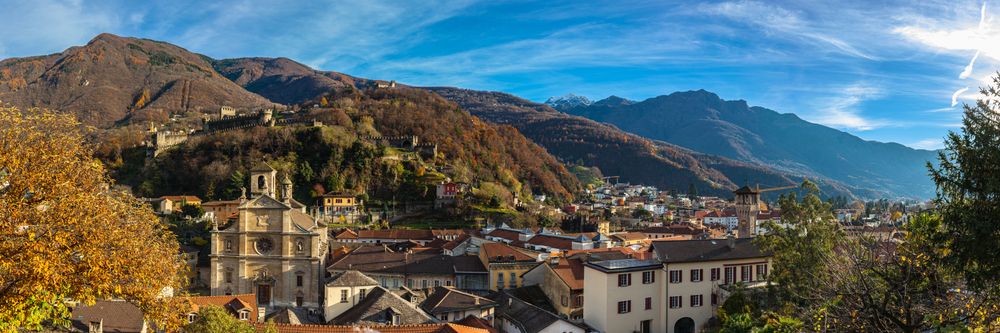
Anyone looking to rent aerial work platforms and construction machinery in Bellinzona usually plans around two constraints: the traffic on the Gotthard axis and the protected historic fabric of the old town. The capital of the canton of Ticino lies where the railway line, the motorway and the cantonal road converge on a narrow valley floor — maintenance work on overhead lines, gantries, noise barriers and bridge soffits therefore takes place within clearly limited possession windows. A few hundred metres further on, the castles stand above alleyways in which a machine manoeuvres with only a few centimetres to spare. Luibl provides tested rental equipment for both situations — from the compact spider lift to the telescopic boom lift with 56.90 m working height.
Gotthard axis: machines that fit into a possession window
On the transit axis it is not the working height that dictates the sequence but the time window. Anyone working on catenary masts, signal gantries, tunnel portals or the soffit of a valley bridge is only given the area after the end of service and has to have cleared it again before the first train in the morning. Setting up, outriggering, working, dismantling — all in the same night. What counts for these sequences are short set-up times, an outrigger footprint that fits between the track area and the traffic space, and a reach that gets to the component without repositioning.
Articulated boom lifts reach up to 48.15 m working height and make it possible to take the platform over a noise barrier or under a superstructure without moving the chassis inside the restricted area. For free-standing masts and tall gantries, telescopic boom lifts go up to 56.90 m. Where work is carried out at night and emissions in residential surroundings matter, electric articulated boom lifts up to 28.00 m are the quieter choice. Plan the lighting of the work area and the dismantling time in from the outset — both decide on approval more often than the choice of machine itself.
Castles, arcades and old-town alleys: access instead of height
In the historic core the problem is reversed: the heights required are moderate, while the set-up areas are tight, irregular and often not accessible by vehicle. Restoration work on rubble stone masonry, wall walks, roof surfaces and vault edges calls for a machine that fits through a gateway, stands on natural ground and spreads the load over an area that the subsoil can carry.
Spider lifts from 13.00 to 39.50 m working height are the obvious class for this: narrow transit width, tracked undercarriage with low ground pressure, variable outriggers for steps and slopes. For indoor work in halls, depots and museum rooms with a flat, load-bearing floor, electric scissor lifts from 6.30 m remain the simplest solution. Before any job on historic ground, the load-bearing capacity of vaults and cellars, the permissible point loads and the requirements of the heritage authority need to be clarified — as a rule this coordination takes more lead time than scheduling the machine.
The rental fleet in figures
| Class | Working height | Platform capacity |
|---|---|---|
| Scissor lifts, electric | 6.30 – 33.00 m | 227 – 1,000 kg |
| Scissor lifts, diesel | 9.70 – 34.00 m | 363 – 1,134 kg |
| High-bay scissor lifts | 18.50 – 33.00 m | 450 – 1,000 kg |
| Articulated boom lifts | 10.89 – 48.15 m | 150 – 450 kg |
| Telescopic boom lifts | 14.00 – 56.90 m | 227 – 454 kg |
| Mast lifts | 10.00 – 12.65 m | 200 kg |
| Spider lifts | 13.00 – 39.50 m | 200 – 400 kg |
Moving material: telehandlers, excavators and forklifts
On the valley floor of the Magadino plain and in the commercial zones along the Ticino, it is rarely a matter of height access alone. Telehandlers with a rigid boom cover 4.30 to 18.80 m lift height at 1.25 to 25 t capacity; rotos reach 15.42 to 38.90 m at 4 to 8 t and set loads down beyond obstacles without the machine having to be repositioned — an advantage when the standing area is wedged in between the railway embankment and the cantonal road. Electric telehandlers from 5.85 to 30.00 m are intended for work in enclosed halls and at night.
Excavators are available from 1.8 to 30 t operating weight — the small classes for service trenches and adaptation work in confined surroundings, the heavy ones for excavation and demolition. For handling in storage and production halls there are forklifts from 3 to 16 t as well as high-lift stackers with 2.70 to 5.50 m lift height and 1.2 to 2.0 t capacity. Where loads have to go precisely behind a building or into a courtyard, a mini crane is often the only option that fits through the access route.
Operator duties at the Ticino site
The law of the country of use applies. In Switzerland, the Ordinance on the Prevention of Accidents and Occupational Diseases (VUV) governs the duties of the operator; the Swiss National Accident Insurance Fund (Suva) exercises supervision and the Federal Coordination Commission for Occupational Safety (EKAS) supplements it with its guidelines. The statutory framework is formed by the Labour Act and the associated ordinances. The inspection of mobile elevating work platforms follows SN EN 280.
The roles are separate: Luibl hands over the inspection certificate, the CE documentation and the operating manual. The risk assessment, the choice of set-up location and the instruction of the operators remain with the hirer, as does the visual and functional check before work begins. In the Italian-speaking environment of Bellinzona there is one further practical point: agree in advance in which language the instruction is given and who authoritatively interprets the operating manual for the operating personnel — on sites with people from several language regions this is the most frequent point of friction. Wind limits, permissible inclination and the load-bearing requirements for the subsoil are machine-specific, are stated in the operating manual of the respective unit and are to be checked against the conditions on site.
Transport to Bellinzona
Delivery runs via the Gotthard axis down onto the valley floor; the surrounding area from Giubiasco via Arbedo-Castione into the Riviera is reached by the same route, as are the Magadino plain towards Locarno and the south of the canton around Lugano. What is decisive for the schedule is less the route than the unloading point: for work in the track area or on the cantonal road we need the approved time slots, for old-town addresses the actual transit width and the permissible axle load of the access route. Let us know the working height, lateral outreach, subsoil, rental period and the access situation — the choice of machine usually follows from that directly.
Frequently asked questions
Which aerial work platform fits into a night-time possession on the Gotthard line?
Set-up time and outrigger footprint are decisive, not the working height alone. Articulated boom lifts up to 48.15 m reach the catenary, the signal gantry and the bridge soffit from a single set-up, so the machine does not have to be repositioned during the possession. For tall masts and portals, telescopic boom lifts up to 56.90 m are available. Allow for erection and dismantling within the same window and agree the unloading point with the site management in advance.
How does a machine get into the alleys of the old town of Bellinzona?
Via the transit width and the subsoil, not via the height. Spider lifts have a narrow tracked undercarriage, spread the load over an area and outrigger safely on steps and on slopes as well. Before scheduling, you should have the narrowest point of the access route, the gateway openings and the load-bearing capacity of vaults or cellars checked.
May aerial work platforms be used on listed historic fabric?
Yes, provided the requirements of the cantonal heritage authority are observed. In practice this concerns anchor points, protection of the surfaces, permissible point loads and the position of the outriggers. The machine itself is rarely the obstacle — it is the approval of the set-up location that needs the lead time. Plan this coordination in before the reservation.
In which language is the instruction given in Bellinzona?
Instructing the operators is the hirer's responsibility and it has to be understandable for the personnel deployed. Clarify in advance which language is binding on the site and who interprets the operating manual. We provide the technical documentation for the machine; with mixed-language teams a written stipulation in the construction sequence is advisable.
At what wind speed does operation on the Ticino valley floor have to be stopped?
There is no generally valid figure — the permissible wind speed is machine-specific and is stated in the operating manual of the respective unit. On the valley floor, gusts frequently occur channelled and in short bursts, which is why the assessment has to be made at the place of work and not on the basis of a regional forecast. Also take into account the wind-exposed surface of the material in the platform.
Which design suits your job? The overview Rent a lifting platform – all platform types at a glance explains scissor lifts, articulating and telescopic boom lifts, mast, spider and truck-mounted lifts and shows what the rental price depends on.