
Rent telehandlers in Dresden: 63 models from 4.30 to 38.90 m
You can rent telehandlers for Dresden from Luibl Rental from 63 models: 19 fixed, 36 roto and 7 heavy-duty telehandlers plus one electric model, with 4.30 to 38.90 m lifting height and 1,250 to 33,000 kg capacity. Whether bricks onto the scaffolding of a Gruenderzeit building in the Neustadt, window elements to a residential block in Prohlis or a plant onto a foundation in the north of Dresden: the right type follows from where the load has to go. The page is structured by this destination, followed by set-up position, attachments, transport from Passau and duties. You will find more machines for the city under construction machinery rental in Dresden.
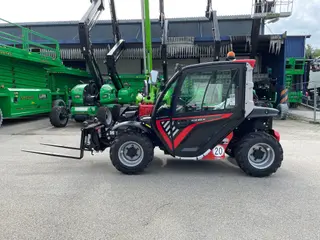
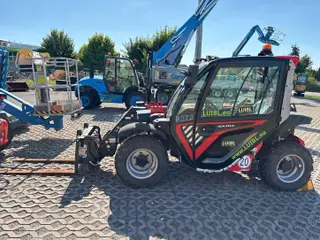
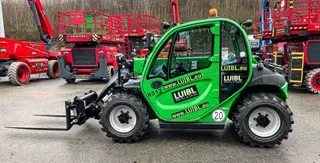
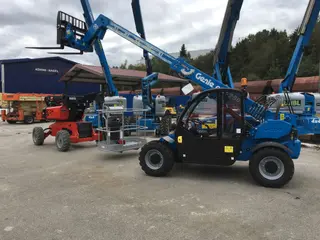
Rent telehandlers in Dresden: the destination of the load determines the type
The table sorts the four types from our rental fleet by the question of where you need to take the load.
| Where does the load have to go? | Type | Rental fleet | Typical use in Dresden |
|---|---|---|---|
| Onto scaffolding, floor slab or lorry, close to the set-up position | Fixed telehandlers | 19 models, 4.30–18.80 m, 1,250–5,500 kg | new build and renovation in Neustadt, Pieschen and Striesen |
| Over a canopy, balcony or building wing | Roto telehandlers | 36 models, 15.42–38.90 m, 4,000–8,000 kg | residential blocks in Prohlis, Gorbitz and Johannstadt, inner courtyards of the old town |
| Onto a foundation or frame, very heavy | Heavy-duty telehandlers | 7 models, 9.40–11.92 m, 7,200–33,000 kg | machines and plants in the north, handling at Alberthafen |
| Into halls and buildings | Electric telehandlers | 1 model, 5.85 m, 2,500 kg | fit-out and assembly in halls in Klotzsche and Hellerau |
You can see the entire fleet under rent telehandlers. What counts for the choice of model is not the greatest lifting height but the permissible load at the outreach at which you place the load. The load chart of each model shows this value.
Load onto the scaffolding: fixed telehandlers for Neustadt and new builds in Dresden
A fixed telehandler drives with the load to the delivery point, lifts and places it. This is sufficient as long as it can stand close in front of the building. The 19 fixed models in the fleet lift 4.30 to 18.80 m high and 1,250 to 5,500 kg.
Gruenderzeit buildings in the Outer Neustadt, Pieschen and Striesen
On four- to five-storey buildings it is usually about pallets of bricks, insulation or roof tiles for scaffolding levels and the attic storey. The streets are narrow and often parked on both sides, so plan a no-stopping zone or a special use permit from the state capital Dresden early on. If the site is in a backyard, the width and height of the gateway decide which model can get in at all. Measure both before your request.
Building plots on the outskirts on the A4 and A17
On open building plots the fixed telehandler stands close to the shell and works without outriggers. The Merlo P 40.17, for example, lifts up to 16.70 m and 4,000 kg, reaches 12.50 m forward and weighs 10,630 kg. With the bucket, the same machine handles soil and bulk material on the plot.
Load over parts of a building: roto telehandlers for residential blocks and the old town
If the load has to go over a canopy, a row of balconies or a building wing, you need a roto telehandler. It stands on outriggers, slews the superstructure and serves several delivery points from one set-up position. The 36 roto models lift 15.42 to 38.90 m high and 4,000 to 8,000 kg.
Refurbishment of residential blocks in Prohlis, Gorbitz and Johannstadt
On the blocks of the large estates, windows, balcony elements and insulation boards are brought into the storeys. With a load hook or cable winch the roto telehandler works like a small crane; for this the driver needs training level 2a. Between blocks, car parks and green areas the set-up area is often tight. Therefore clarify access and outrigger area in advance with the housing company.
Old town around Neumarkt, Zwinger and Residenzschloss
Many work positions lie behind barriers, open staircases or green areas. With a large outreach the telehandler stays outside them: the Magni RTH 6.39SH lifts up to 38.90 m, reaches 27.00 m and carries up to 6,000 kg. It measures 8.60 × 2.54 × 3.12 m and weighs 24,000 kg; set-up area and ground must match. On monuments you coordinate the job with the heritage protection authority; on public ground you need the city's permit.
Tram overhead lines
Tram overhead lines hang above many Dresden streets. The boom must keep the prescribed clearance from them. Clarify shutdown or protection with Dresdner Verkehrsbetriebe (DVB) before the telehandler works near them.
Load onto a foundation or into the hall: heavy-duty and electric in the north of Dresden
Around Klotzsche, Hellerau and the airport as well as in the commercial area at the Dresden-Nord motorway junction there are plants, halls and logistics areas. There it is often not about height but about weight or work inside the building. On plant sites the operator's registration, induction and routes apply. Clarify these before the machine arrives.
Heavy-duty telehandlers up to 33,000 kg
The 7 heavy-duty models lift 7,200 to 33,000 kg to 9.40 to 11.92 m. They place machines, control cabinets, steel parts or pipe bundles onto foundations and frames. If the load's centre of gravity is off-centre, the permissible load decreases, which is why we need the weight and centre of gravity. Also check the route, doors and floor slab for the total weight of machine and load.
Electric telehandler inside the building
For fit-out and assembly in halls there is the Manitou MT 625e: 5.85 m lifting height, 3.40 m reach, 2,500 kg capacity, 1.81 m wide and 1.92 m high. It produces no local emissions during operation. Plan a charging point with a power supply.
Set-up position for the telehandler in Dresden: prepare the Elbe floodplain and slopes
Before the load reaches its destination, the telehandler must stand safely. In Dresden two locations require special preparation.
Elbe meadows and banks
The Elbe meadows between the old town, Neustadt, Johannstadt and Pieschen are a flood area with soft floodplain soils. Via wheels and outriggers a telehandler transfers high point loads into the ground. Lay access routes and outrigger areas with plates or mats and keep an eye on the Elbe water level; after flooding or heavy rain the ground must be reassessed. For municipal areas on the river you need the owner's consent.
Elbe slopes in Loschwitz, Wachwitz and Weisser Hirsch
The plots on the slopes are steep, the access roads narrow. Each model has a permissible inclination stated in the data sheet. The set-up position must be level enough or prepared. A model with more outreach is often the better choice, because it works from the street and does not need to drive onto the plot.
Attachments for the telehandler in Dresden
In addition to the forks, you can rent five attachments:
-
Bucket for soil and bulk material on building plots.
-
Work platform for work at height, driver with level 2b. For longer facade work a telescopic boom lift is often the better choice.
-
Load hook for slung loads such as window elements or beams.
-
Cable winch for lifting and fine lowering.
-
Lattice jib winch for more hook height over roof edges.
For small loads in tight courtyards or inside buildings, it is worth looking at the mini crane in Dresden.
Transport of the telehandler from Passau to Dresden
From our location in Passau it is around 470 km to Dresden via Regensburg, the A93, the A72 and the A4. The telehandler arrives on a low-loader. At the site the lorry needs a load-bearing area for unloading and an access route without passages that are too low. Give us the site address and we will plan the transport. We also deliver to Radebeul, Freital, Pirna, Heidenau and Meissen as well as to Chemnitz.
Duties for telehandlers in Dresden: DGUV Regulation 68 and DGUV Principle 308-009
The telehandler may only be driven by someone who is at least 18 years old, suitable, trained and authorised in writing by the employer. This is required by section 7 of DGUV Regulation 68.
Training in three levels under DGUV Principle 308-009
The basic training in level 1 covers fixed telehandlers. Anyone driving a roto telehandler or lifting with load hook and winch also needs level 2a; level 2b applies to the work platform. At handover we familiarise the driver with the model; this does not replace a missing level.
Risk assessment and instruction on site
Under section 3 of the Industrial Safety Regulation (BetrSichV) the employer assesses the hazards, in Dresden for example soft Elbe meadows, slopes, tram overhead lines and passers-by in the old town. Instruction is prescribed by section 12 of the Occupational Safety and Health Act (ArbSchG) and section 12 BetrSichV. If your staff lack a level, we provide information on training via certified partners free of charge and without obligation and put you in touch with a suitable provider.
Request a telehandler for Dresden
Tell us where the load has to go, how heavy it is and where the telehandler can stand, plus the site address, period and attachment. We will suggest one of our 63 models and plan the delivery from Passau.