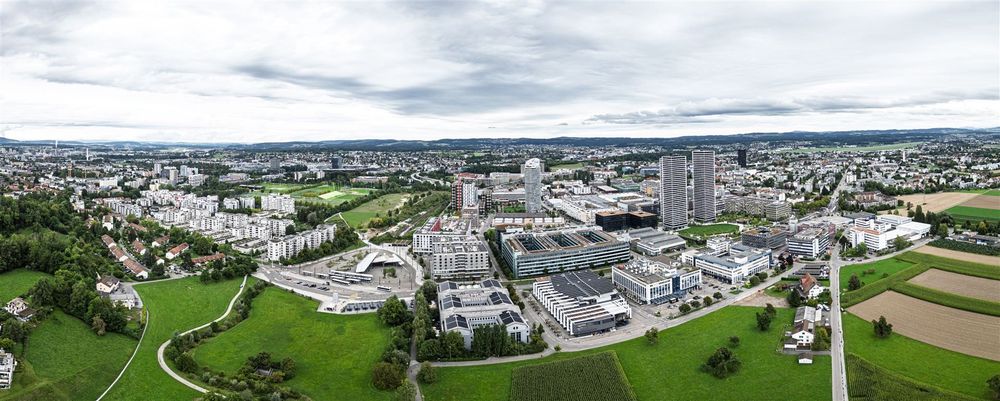
Rent aerial work platforms and construction machinery in Duebendorf
Renting aerial work platforms and construction machinery in Duebendorf usually means working inside a building that follows different rules than an ordinary construction site. On the airfield site and around the innovation and research park, laboratory, pilot-plant and university buildings stand next to halls with very large spans, with the commercial estates of the Glattal in between. Sometimes cleanliness decides which machine is chosen, sometimes the eaves height. Luibl provides tested rental machines for both — from the compact electric unit for the clean area to the platform that reaches under a hangar roof — and delivers to site on its own low-loader.
Laboratory and research buildings: working under access and cleanliness requirements
In laboratory, testing and pilot-plant areas the platform is a foreign body that has to fit in. Three things are almost always a given: no exhaust fumes, no marking tyres, no drop of oil on the floor. Electric scissor lifts are the basic equipment for this — locally emission-free, from 6.30 m working height and therefore usable even in rooms with a suspended ceiling. The work itself is almost always overhead: ventilation ducts, service runs for gases and purified water, cable trays, extraction connections, lighting above work islands.
Where these runs pass above fixed installations — laboratory benches, safety cabinets, test rigs — a straight lifting movement will not get you to the work point. An articulated boom lift then guides the platform over the obstacle; in the electric version it reaches 10.89 to 28.00 m with 150 to 280 kg platform capacity. For individual points in narrow corridors and plant rooms a mast lift with 10.00 to 12.65 m and 200 kg is often enough — it fits through standard doors and can be repositioned by one person.
In organisational terms: clarify access, airlock procedure and cleaning of the machine before delivery. The usual requirements are cleaning of the tyres before entry, taped-off transitions and a fixed contact on the operator's side who releases the area. We deliver the machine cleaned and document its condition at handover, so that clearance does not fail on a formality.
Hangar and hall buildings on the airfield site: large spans, high eaves
The second focus in Duebendorf is literally higher up. Hangars and halls with widely spanned truss roofs have hardly any intermediate supports — the work point is high and often far away from any wall. This is exactly what articulated boom lifts in the diesel version are designed for: 11.91 to 48.15 m working height with 227 to 450 kg platform capacity, with an outreach that brings the platform right into the bay between two trusses. Typical tasks are corrosion protection on steel components, installation and maintenance of door drives, hall lighting, fire alarm technology and suspension points for crane systems.
For area work under the roof — cleaning, painting, full-surface inspection — scissor lifts are the more efficient choice, because the large platform carries more material and more people: up to 33.00 m in the electric version and up to 34.00 m in the diesel version with up to 1,134 kg platform capacity. For work on the outer shell, at the eaves and the roof edge, you reach for telescopic boom lifts with 14.00 to 56.90 m. If the machine stands on an unpaved apron or on grass pavers, tracked (spider) lifts with 13.00 to 39.50 m are the gentler option, because they spread their weight over the track area.
The rental fleet in figures
| Class | Working height | Platform capacity |
|---|---|---|
| Scissor lifts, electric | 6.30 – 33.00 m | 227 – 1,000 kg |
| Scissor lifts, diesel | 9.70 – 34.00 m | 363 – 1,134 kg |
| High-bay scissor lifts | 18.50 – 33.00 m | 450 – 1,000 kg |
| Articulated boom lifts | 10.89 – 48.15 m | 150 – 450 kg |
| Telescopic boom lifts | 14.00 – 56.90 m | 227 – 454 kg |
| Mast lifts | 10.00 – 12.65 m | 200 kg |
| Tracked lifts | 13.00 – 39.50 m | 200 – 400 kg |
Telehandlers, excavators and forklifts in the Glattal
Research and hall buildings bring heavy, bulky equipment with them — test rigs, air-conditioning units, transformers, ventilation plant. Telehandlers take over the placing where a crane would be disproportionate: rigid with 4.30 to 18.80 m lift height and 1.25 to 25 t capacity, as a roto machine with 15.42 to 38.90 m and 4 to 8 t when work has to be carried out over a roof or over a row of buildings in front. Inside a clean hall, electric telehandlers with 5.85 to 30.00 m and 2.5 to 7 t work free of exhaust emissions.
For site development, utility lines and foundations in the Glattal, excavators from 1.8 to 30 t operating weight are available; the small classes are suitable for digging between existing service runs, where every centimetre counts. In building operations, forklifts from 3 to 16 t and high-lift stackers with 2.70 to 5.50 m lift height and 1.2 to 2.0 t capacity complete the fleet — for example when laboratory equipment has to be stored temporarily during a conversion and brought back in afterwards.
Documentation, clearance and operator duties
In research properties the operator's side checks more closely than elsewhere before an external machine drives in — documentation is part of access here. Swiss law applies: the Ordinance on the Prevention of Accidents and Occupational Diseases (VUV) sets the framework, the Swiss National Accident Insurance Fund (Suva) implements and supervises it, and the guidelines of the Federal Coordination Commission for Occupational Safety (EKAS) make it concrete; above these stand the Labour Act and its ordinances. Mobile elevating work platforms are subject to recurring inspection to SN EN 280. With every rental machine you receive the valid inspection certificate, the CE documentation and the operating manual; as a rule that is enough for clearance by the building services department. What remains with the hirer: the risk assessment for the specific room, the instruction of the operators and the visual and function check before every start of work.
Transport to Duebendorf
Delivery into the Glattal is unproblematic; the last fifty metres often are not. What matters are door height and door width, the load-bearing capacity of floors above basement levels, and the question of whether the machine reaches its place via a ramp, an airlock or a goods lift. Give us these figures with your enquiry and we will clarify in advance whether one machine fits or whether two smaller units are the better solution. On the airfield site we align delivery with the access and operating times of the site. Larger projects we schedule together with the locations in Zurich and Winterthur, so that several classes remain available in parallel.
Frequently asked questions
Which aerial work platform may enter a laboratory or clean area in Duebendorf?
In practice an electric machine with non-marking tyres and a clean chassis — usually an electric scissor lift, or an electric articulated boom lift where there are obstacles. We deliver the machine cleaned and document its condition at handover. The specific requirements are set by the operator's side: clarify the airlock procedure, the cleaning steps and the clearance before the delivery date, so that the machine is not left standing at the gate.
How do I reach ventilation and service runs that pass above fixed laboratory benches?
With an articulated boom lift. Its platform is guided over the installation to the work point instead of stopping vertically in front of it. The electric version offers 10.89 to 28.00 m working height with 150 to 280 kg platform capacity. Check the free set-up area in front of the laboratory bench and the permissible floor load in advance — both limit the size of the machine more than the ceiling height does.
Which machine fits under a widely spanned hangar roof?
For point work in the middle of the truss bay, a diesel articulated boom lift with 11.91 to 48.15 m working height and 227 to 450 kg platform capacity. If the task is area work under the roof, a scissor lift is more economical, because the larger platform carries more material and more people. The decisive factors are the eaves height, the horizontal distance to the nearest trafficable point and the load-bearing capacity of the hall floor.
Can I work indoors and outdoors with the same machine in Duebendorf?
Rarely sensible. Indoor areas call for electric drive and clean tyres, outdoor areas often for diesel or a tracked chassis because of the ground and the gradient. For mixed projects we recommend scheduling two machines rather than overtaxing one machine with both tasks. Where they are used in parallel, the rental period of the two machines can be set differently.
Which documents do I receive with the rental machine?
Every machine comes with the valid inspection certificate to SN EN 280, the CE documentation and the operating manual. With these you demonstrate to the building services department and the site management that the machine complies with the inspection requirements. Not included are the site-specific risk assessment and the instruction of the operators — under the VUV these remain with the hirer. Machine familiarisation at handover is possible by arrangement.
Working height, outreach and ground conditions determine the right machine. A comparison of all designs with costs and inspection duties is available at Rent a lifting platform: platform types, costs and applications.