
Rent telehandlers in Duisburg for port, plant and construction site
You can rent telehandlers for Duisburg from Luibl Rental from 63 models: 19 fixed, 36 roto and 7 heavy-duty telehandlers plus one electric model, with 4.30 to 38.90 m lifting height and 1,250 to 33,000 kg capacity. In Duisburg, port logistics at the confluence of the Rhine and Ruhr, large steel and plant works and new residential quarters meet in a small area. Each of these industries places different demands on lifting height, capacity and set-up position. That is why this page sorts the fleet by industry. We deliver from our location in Passau; you will find more machines for the city under construction machinery rental in Duisburg.
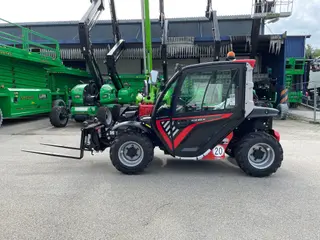
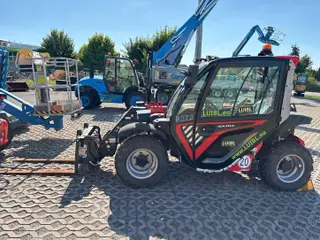
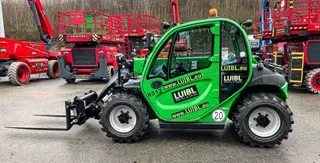
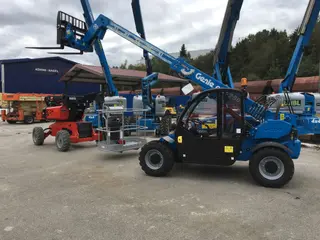
Rent telehandlers in Duisburg: every industry needs a different type
The table shows which type from the fleet typically suits which task in Duisburg. All values come from the data sheets of our telehandlers.
| Industry in Duisburg | Typical task | Type from the fleet |
|---|---|---|
| Port and logistics | assembly on hall roofs and facades, handling on open areas | roto 15.42–38.90 m, 4,000–8,000 kg |
| Steel and plant engineering | lifting components and units during overhaul or shutdown | heavy-duty 7,200–33,000 kg, 9.40–11.92 m |
| Residential and quarter construction | pallets, insulation and scaffolding parts onto floor slabs and roofs | fixed 4.30–18.80 m, 1,250–5,500 kg |
| Fit-out in halls and buildings | transporting and lifting material inside the building | electric MT 625e, 5.85 m, 2,500 kg |
| Infrastructure and pipeline construction | placing pipes, manhole rings and formwork on the hook | roto with load hook or cable winch |
The industry sets the direction; the decision is made on the load chart. So always tell us the weight, height and distance of the heaviest load.
Port and logistics: roto telehandlers reach hall roofs in Duisburg from one set-up position
The Port of Duisburg is one of the largest inland ports in Europe. Between Ruhrort, the harbour basins and the logistics areas in Rheinhausen stand large warehouses with wide roof areas. A roto telehandler is suitable for work on them: it stands on outriggers, rotates superstructure and boom and places material at several points without repositioning.
Large halls demand outreach
The largest roto model, the Magni RTH 6.39SH, achieves 38.90 m lifting height and 27.00 m horizontal outreach with 6,000 kg capacity. As the outreach increases, the permissible load decreases. For roof elements, roof lights or ventilation units on long halls, the distance to the middle of the hall therefore counts, not just the eaves height.
Port sites have their own rules
On port and logistics areas, the operator's requirements for access, set-up area and distance from the quay wall apply. Clarify these before ordering and tell us the gate for delivery. Where lorries and handling equipment drive constantly, cordoning off the slewing area is part of the planning.
Steel and plant engineering: heavy-duty telehandlers lift up to 33,000 kg in Duisburg plants
Duisburg is a major steel location; ironworks operate in the north and south of the city, plus suppliers and mechanical and plant engineering companies. During overhauls and planned shutdowns, motors, gearboxes, rolls or steel components have to be replaced in a short time. For this, seven heavy-duty telehandlers with 7,200 to 33,000 kg capacity and 9.40 to 11.92 m lifting height are available.
Plant approval before use
In plants the operator decides where a machine may drive and set up its outriggers. Register the dimensions and weight of the telehandler in good time and clarify routes, bridges over utility corridors and areas with special requirements. For shutdowns with a fixed time window we recommend booking early.
What the data sheet promises only applies at the standard load centre
A gearbox or roll rarely has its centre of gravity exactly where the load chart assumes it. If it is further from the fork carriage or offset to the side, the machine may take noticeably less. So send us a sketch with weight, dimensions and centre of gravity. This shows whether a heavy-duty telehandler is sufficient, a roto on the hook works more safely, or a forklift with a short load is the simpler solution.
Residential and quarter construction: fixed telehandlers supply Duisburg sites up to 18.80 m
New residential and office quarters are being built in Duisburg on former railway, port and industrial land, for example in Wedau or around the Inner Harbour. Most buildings there are below 18.80 m. For them a fixed telehandler is sufficient: it drives up with forks and lifts blocks, insulation boards or scaffolding parts onto floor slabs and roofs.
Building plots: speed on paved routes
One example from the fleet is the Merlo P 40.17 with 16.70 m lifting height, 12.50 m forward reach and 4,000 kg capacity at an operating weight of 10,630 kg. On large building plots it shuttles between the storage area and the shell. Plan a load-bearing site road for this.
Existing buildings in the city centre and districts
In dense streets of the city centre, Ruhrort or Hochfeld there is often no space next to the building. If the machine stands on a pavement or carriageway, you need a special use permit and usually a traffic order from the city of Duisburg. Watch out for tram and railway overhead lines. If the height is not enough, switch to roto, because it slews over front gardens and courtyards.
Fit-out and halls: the electric telehandler works in Duisburg without exhaust fumes on site
For work in buildings, warehouses and workshops there is the Manitou MT 625e. The electric model takes 2,500 kg, lifts it to 5.85 m and pushes it 3.40 m forward. At 1.81 m wide and 1.92 m high it fits through many roller doors of workshops and warehouses. No exhaust fumes are produced on site when driving, so staff in the hall can continue working.
Clarify three things in advance: whether the door and aisles are wide enough, whether the hall floor can take the dead weight of 4,800 kg plus load, and where the machine will be charged overnight. If warehouse operations continue, define separate routes and distances to the racks.
Ground in Duisburg: check old mining, backfill and floodplain soils before setting up outriggers
A telehandler transfers its own weight and the load to the ground via wheels or outriggers. In Duisburg you will encounter three ground situations that you should clarify beforehand.
Old mining in the north
In the north of Duisburg hard coal was mined for a long time. Indications of mining subsidence or old shafts belong in the risk assessment. The mining and energy department of the Arnsberg district government provides information.
Backfilled industrial land
Former ironworks, railway and port areas often consist of backfilled soil. The load-bearing capacity changes over short distances there; backfilled cable trenches give way under an outrigger. Place load distribution plates underneath and have uncertain areas assessed in advance.
Rhine and Ruhr floodplain
Near the banks the ground is soft after rain or flooding. In the fleet the operating weight ranges from 4,800 kg for the MT 625e to 24,000 kg for the Magni RTH 6.39SH. A lighter machine or a set-up position on a paved area protects the ground.
Attachments turn the telehandler in Duisburg into a lifting, loading or assembly machine
In addition to the forks, you can rent the following attachments:
| Attachment | Example from Duisburg |
|---|---|
| Bucket | bulk material, gravel and excavated soil in depots and storage areas |
| Load hook | pipes and manhole rings in pipeline construction, steel parts in the plant |
| Cable winch | lowering loads under control into pits, shafts or openings |
| Lattice jib winch | assembly over roof edges of large halls |
| Work platform | short jobs on doors, lights or gutters |
Hooks and winches turn the telehandler into a machine for crane mode, the platform into one for lifting persons. For both, the driver needs a separate training level. Anyone working at height for hours or days is usually better served with a telescopic boom lift.
Transport to Duisburg: around 690 km from Passau almost entirely via the A3
Between our location in Passau and Duisburg there are around 690 km, almost the entire route via the A3 to the Kaiserberg interchange. The electric MT 625e fits on a lorry. The Magni RTH 6.39SH at 8.60 m long, 2.54 m wide, 3.12 m high and 24,000 kg travels on a low-loader; for some models the transport requires a permit. So schedule large machines early.
We also deliver to the neighbouring cities, for example Oberhausen, Muelheim an der Ruhr, Moers, Essen, Krefeld or Dinslaken. For what applies further up the Rhine, see telehandler rental in Duesseldorf. On site the driver needs a level, paved area for unloading. The delivery costs are shown in your quotation; more under Transport.
Duties for telehandlers in Duisburg: DGUV Regulation 68 and DGUV Principle 308-009
Only someone who is of age, suitable for the job, trained and holds a written driving authorisation from the employer may sit at the controls of a telehandler. This is required by section 7 of DGUV Regulation 68 for industrial trucks.
DGUV Principle 308-009 has three levels
Basic training (level 1) applies to fixed machines. Anyone driving roto telehandlers or lifting with hook and winch also needs level 2a; anyone using the work platform needs level 2b. Our familiarisation at handover shows the operation and particularities of the delivered model; it does not replace a training level.
Assess hazards in Duisburg in advance
Before use, the employer prepares a risk assessment under section 3 of the Industrial Safety Regulation (BetrSichV). In Duisburg this often includes old mining, backfilled soils, quay edges, plant traffic and overhead lines. Instruction takes place under section 12 of the Occupational Safety and Health Act (ArbSchG) and section 12 BetrSichV. If your team lacks a level, we provide information on training via certified partners free of charge and without obligation and put you in touch with a suitable provider.
Request a telehandler for Duisburg: industry, load and set-up position are enough
Tell us your industry and task, the weight, height and distance of the heaviest load, the ground at the set-up position and the attachment you need, plus the site address and period. We will suggest one of our 63 models and plan the transport from Passau.