Rent aerial work platforms and construction machinery in Sion
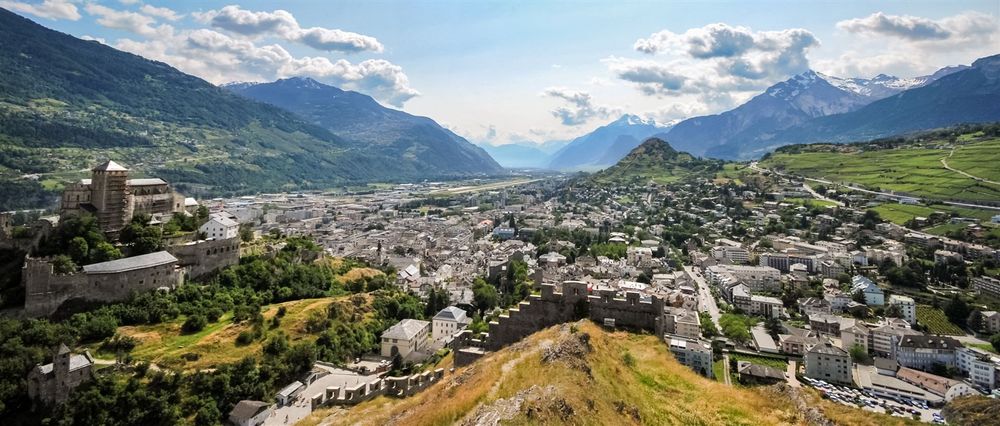
In Sion, the choice of aerial work platforms and construction machinery is almost always decided by the gradient of the area on which the machine is to stand. The capital of Valais lies in the Rhone valley between two castle hills, and the vineyard terraces begin immediately behind the last row of houses, with gradients that scarcely occur in flat country. Added to this are rock faces above the town, retaining walls along the access roads and wine industry businesses whose buildings are in use all year round and released for work only in certain weeks. For this, Luibl hires out inspected machines that can also be used away from level standing areas — from the spider lift to the articulating boom lift with 48.15 m working height.
Vineyard terraces, retaining walls and rock faces
On a slope, the problem is not the height but the stand. Dry stone walls on vineyard terraces, cable haulage installations, irrigation lines, netting and rockfall protection above the town: everywhere there the set-up area is narrow, inclined and rarely surfaced. Spider lifts from 13.00 to 39.50 m working height are the standard answer here — tracked undercarriage instead of wheel drive, a low centre of gravity when travelling, individually adjustable outriggers for steps and slopes, low ground bearing pressure on undisturbed ground.
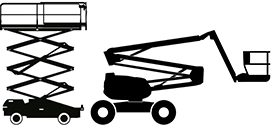
Where the area beneath is load-bearing but the target lies far above an edge or behind a wall, articulating boom lifts play to their strength: they reach up to 48.15 m working height and take the platform around obstacles instead of driving straight at them. For work in wineries and processing buildings — lights, ventilation, tank cleaning equipment, ceiling structures above fermentation and storage rooms — electric scissor lifts from 6.30 m are the workable choice, because they operate without exhaust fumes and are gentle on the floor. Depending on the area, requirements apply regarding cleaning, leak protection and admissibility of entry; clarify these with the business before the machine comes into the building.
Valley wind: why daily planning in the Rhone valley looks different
The Rhone valley channels the wind. In Sion and along the valley axis it freshens on many days during the course of the morning and reaches its maximum in the afternoon — for work at height that is the most frequent reason to interrupt or postpone a job. Anyone who knows this puts wind-sensitive activities into the early hours: facade elements, sheet metal, panels, netting and everything that presents a large exposed area in the platform.
Specific limit values cannot be stated in general terms. The permissible wind speed depends on the machine and is given in the operating manual of the machine concerned; it depends on the design, the outreach and the platform load and does not apply across types. What governs is the assessment at the place of work, not a regional forecast — in a valley wind, values on an open area and in the lee of a slope differ considerably. Three points have proved themselves in practice: actually watch the machine's wind measurement, limit the material in the platform to what is necessary, and establish in advance who stops the work and how the machine is then set down. On assignments lasting several days, the question of the position in which the machine is left overnight also belongs here.
The rental fleet in numbers
| Class | Working height | Platform capacity |
|---|---|---|
| Scissor lifts, electric | 6.30 – 33.00 m | 227 – 1,000 kg |
| Scissor lifts, diesel | 9.70 – 34.00 m | 363 – 1,134 kg |
| High-rack scissor lifts | 18.50 – 33.00 m | 450 – 1,000 kg |
| Articulating boom lifts | 10.89 – 48.15 m | 150 – 450 kg |
| Telescopic boom lifts | 14.00 – 56.90 m | 227 – 454 kg |
| Mast lifts | 10.00 – 12.65 m | 200 kg |
| Spider lifts | 13.00 – 39.50 m | 200 – 400 kg |
Loads on the slope: telehandlers, excavators and forklifts
On a steep slope, the route the material takes is often more demanding than the work itself. Roto telehandlers with 15.42 to 38.90 m lift height and 4 to 8 t capacity set pallets, walling stone or plant components down across the edge of a terrace without the machine having to follow the slope. Rigid telehandlers cover 4.30 to 18.80 m at 1.25 to 25 t and take on transport on unsurfaced terrain; electric models from 5.85 to 30.00 m are intended for assignments in halls and in the immediate vicinity of processing areas.
Excavators are available from 1.8 to 30 t operating weight — the small classes for irrigation and service lines between the terraces, the heavy ones for excavation, wall foundations and demolition. In wineries, bottling plants and stores, forklifts from 3 to 16 t are used; for narrow storage aisles with a finished floor, high-lift stackers with 2.70 to 5.50 m lift height and 1.2 to 2.0 t capacity are the more suitable class. Where neither loader nor crane can get through, the mini crane remains as the alternative for placing loads precisely.
Inspection, documentation and who answers for what
Assignments in Valais are subject to Swiss law. The operator obligations arise from the Ordinance on the Prevention of Accidents and Occupational Diseases (VUV); SUVA takes on implementation and supervision, the directives of the Federal Coordination Commission for Occupational Safety (EKAS) make the requirements specific, and the framework is set by the Labour Act and its associated ordinances. Mobile elevating work platforms are inspected in accordance with SN EN 280.
Luibl provides the inspection certificate, CE documentation and operating manual. What happens at the place of work is the hirer's responsibility: the risk assessment, determination of the set-up location, instruction of the operator and the visual and functional check before work begins. On a slope, the assessment of the standing area deserves particular attention — gradient, load-bearing capacity of the ground, proximity to wall copings and embankment edges, risk of slipping after rainfall. In the French-speaking environment of Sion there is the additional question of the language in which instruction is given and who authoritatively interprets the operating manual for the operating personnel; that should be settled in writing before work begins and not first on site.
Transport to Sion
Delivery runs along the valley axis of the Rhone valley; Sion itself, the commercial zones on the valley floor and the neighbouring municipalities are therefore unproblematic to reach. It becomes demanding over the last few metres: vineyard tracks, hillside approaches and farm roads often have restricted width, tight hairpin bends and weight restrictions. Tell us therefore not only the address but the access route — the width at the narrowest point, the gradient, the surface, the possibility of turning and whether outriggers can be set at the destination. For projects further west on Lake Geneva, in the Lausanne area for example, different conditions apply; that too can be agreed in one go. With the working height, lateral outreach, ground conditions and period, the right machine is usually arrived at quickly.
Frequently Asked Questions
Which aerial work platform stands safely on a vineyard terrace?
In most cases a spider lift with individually adjustable outriggers. It distributes the load over the tracked undercarriage, copes with undisturbed ground and compensates for steps and gradients. The permissible inclination depends on the machine and is laid down in the operating manual; it has to be checked before setting up. Proximity to wall copings and embankment edges belongs in the risk assessment.
How do you deal with the valley wind in the Rhone valley?
Wind-sensitive work is carried out as early in the day as possible, because the valley wind typically freshens during the course of the morning. Limit the exposed area in the platform, watch the machine's wind display and establish beforehand who interrupts the work. Fixed limit values cannot be stated in general terms — they are given for each machine in the operating manual.
May aerial work platforms be used in wineries and processing rooms?
Yes, if the business releases the area and the hygiene requirements are complied with. For interior areas, electric machines are an option, because they operate without exhaust fumes and are gentle on the floor. What has to be clarified in advance is access and clearance heights, floor load capacity, cleaning of the machine before it is brought in, and the period during which the area is not in productive use.
Which machine reaches the rock faces and walls above the town?
For work above an edge, articulating boom lifts up to 48.15 m working height are suitable, because the platform can be taken around obstacles. The precondition is a load-bearing standing area within reach. If that is not available, a spider lift set up closer to the object is usually the more viable solution.
In which language is the operating personnel instructed in Sion?
That is determined by the hirer — instruction is an operator obligation and has to be comprehensible for the people deployed. In French-speaking Valais, a written stipulation in the construction schedule is advisable, particularly with teams from several language regions. The technical documentation and the operating manual for the machine are handed over with it.
Before you enquire, it is worth looking at the designs: at Rent a lifting platform you will find all platform types from the scissor lift to the truck-mounted platform with their strengths, typical applications and operator duties.