Rent aerial work platforms and construction machinery in Chur
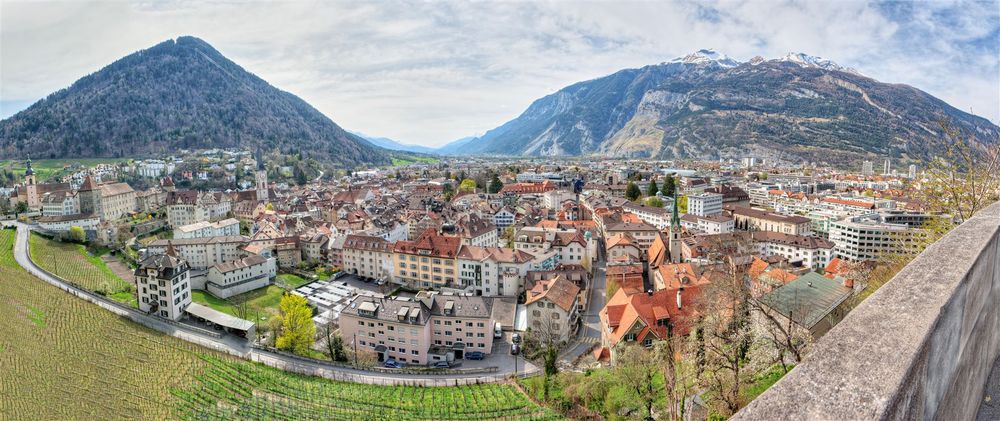
Aerial work platforms and construction machinery are rarely rented in Chur for a job in Chur alone — the cantonal capital is the transhipment point from which the construction sites in the side valleys of the Grisons are supplied. Whatever is loaded here onto a low-loader or a swap-body train then has to be brought over mountain passes, tight hairpin bends and access roads that are not always open in winter. That shifts the choice of equipment: transport dimensions, dead weight, gradeability and winter capability often count for more in the Alpine region than the last few metres of working height. Luibl rents out tested aerial work platforms and construction machinery for both levels — the construction industry in the Chur Rhine Valley and the jobs further up the valley.
Transhipment point for the side valleys of the Grisons
Anyone scheduling from Chur plans the access route before the machine. Turning radii, tunnel profiles, weight restrictions on valley bridges and the gradient of the final approach decide what actually arrives at the top. Compact tracked (spider) lifts from 13.00 to 39.50 m working height are the most rewarding class for this: low dead weight in relation to reach, a narrow transport width and a crawler undercarriage that still works on gravel, on frozen ground and on a slope where wheeled chassis reach their limit.
On load-bearing, level ground — depots, halls, paved construction sites — scissor lifts remain the most economical choice; the diesel versions cover 9.70 to 34.00 m and carry up to 1,134 kg, which is decisive for installation work with material in the platform. For work on retaining walls, avalanche barriers and valley bridges where the platform has to be taken far out over an edge, articulated boom lifts reach up to 48.15 m. Altitude and temperature influence the operating behaviour; which limits apply for wind, inclination and snow load depends on the machine and is laid down in the operating manual of the respective unit. Between late autumn and spring you also have to allow for a machine staying up there longer than planned if a road is closed.
Mountain railways and tourism buildings: the windows between the seasons
The second thing setting the pace in the Grisons is the seasonal calendar. Hotels, mountain restaurants, valley stations, workshops and cable car infrastructure are overhauled in spring and in autumn — in weeks, not in months. In these windows, facade and roof work, inspections of towers and drive rooms, lighting and snowmaking technology and the interior fit-out frequently run in parallel on the same area.
For interior work in hotel lobbies, restaurants and workshops, electric scissor lifts from 6.30 m are the uncomplicated solution: no exhaust fumes, a small set-up width, gentle on finished floors. Mast lifts with 10.00 to 12.65 m working height and 200 kg platform capacity are suitable for lighting, ventilation equipment and sprinklers in areas where the flooring has already been laid. Outside, on station buildings and towers, tracked lifts still work even where the surface is unpaved. Important for planning: in these short windows several trades compete for the same machines — reserving early is the most effective lever.
The rental fleet in figures
| Class | Working height | Platform capacity |
|---|---|---|
| Scissor lifts, electric | 6.30 – 33.00 m | 227 – 1,000 kg |
| Scissor lifts, diesel | 9.70 – 34.00 m | 363 – 1,134 kg |
| High-bay scissor lifts | 18.50 – 33.00 m | 450 – 1,000 kg |
| Articulated boom lifts | 10.89 – 48.15 m | 150 – 450 kg |
| Telescopic boom lifts | 14.00 – 56.90 m | 227 – 454 kg |
| Mast lifts | 10.00 – 12.65 m | 200 kg |
| Tracked (spider) lifts | 13.00 – 39.50 m | 200 – 400 kg |
Lifting, digging, stacking: the rest of the site
In the Alpine region a roto telehandler frequently replaces a crane that would have no space on the site. Rotos reach 15.42 to 38.90 m lift height with 4 to 8 t capacity and set loads down over embankments and roofs without the machine being repositioned. Rigid telehandlers cover 4.30 to 18.80 m with 1.25 to 25 t and are the workhorses for moving material on unpaved terrain; electric versions from 5.85 to 30.00 m are intended for halls and emission-sensitive areas.
Excavators are available from 1.8 to 30 t operating weight — small classes for utility lines, drainage lines and adjustment work on a slope, large ones for excavation and demolition. For handling in depots and stores there are rough-terrain forklifts, which also travel safely on gravel and on a gradient, as well as counterbalance forklifts from 3 to 16 t and high-lift stackers with 2.70 to 5.50 m lift height. Where the access is too narrow for everything else, the mini crane remains.
Proof of inspection and responsibility at the site
Swiss law applies to jobs in the Grisons. The Ordinance on the Prevention of Accidents and Occupational Diseases (VUV) lays down the operator's duties, the Swiss National Accident Insurance Fund (Suva) is the enforcement and supervisory body and the directives of the Federal Coordination Commission for Occupational Safety (EKAS) set out the requirements in detail; above them stand the Labour Act and its ordinances. Mobile elevating work platforms are tested in accordance with SN EN 280.
The division of tasks is unambiguous: from Luibl come the proof of inspection, the CE documentation and the operating manual. The hirer is responsible for the risk assessment for the specific site, the instruction of the operators and the visual and function check before work begins. In the mountains the assessment additionally has to cover the points that rarely come up in the lowlands: the load-bearing capacity and the frost condition of the ground, the inclination of the set-up area, snow load and roof avalanches, visibility in early dusk and the escape route in the event of a sudden change in the weather. Permissible wind and snow load values cannot be transferred across the board — they differ from machine to machine and are given in the respective operating manual.
Transport to Chur
Chur lies at the end of the motorway and at the beginning of the valley roads — both shape the delivery. For the Chur Rhine Valley and the commercial areas towards Landquart and Domat/Ems the access is uncritical; for jobs in the Praettigau, the Schanfigg, the Surselva, the Albula Valley or the Engadin we need the details of the final approach: the width at the narrowest point, the gradient, the surface, the turning space at the destination and whether the route is open in the season in question. Different conditions apply to projects on the Swiss Plateau — in the Bern area, for instance — so please talk to us about those separately. Tell us the working height, the lateral outreach, the ground conditions and the rental period, and we will coordinate machine and transport together with you.
Frequently asked questions
Which aerial work platform is suitable for a construction site in a side valley of the Grisons?
As a rule a tracked lift. It is narrow enough for tight hairpin bends and access roads, puts comparatively little weight on the axle at 13.00 to 39.50 m working height and still travels safely on unpaved, sloping ground. The decisive factor is the narrowest point of the access — tell us the width, the gradient and the surface before the machine is scheduled.
Can aerial work platforms be used at altitude in winter?
Yes, with the appropriate planning. Frost and icing of the ground, snow load on the set-up area, roof avalanches, short hours of daylight and possible road closures that keep the machine at the site for longer all have to be taken into account. Operating limits for wind and snow load depend on the machine and are documented in the operating manual — there are no blanket values.
When should machines be reserved for overhauls at mountain railways and hotels?
As early as possible. The maintenance windows fall in spring and in autumn and last only weeks; during this time several trades enquire about the same types of machine at once. Anyone who reports the period and the required working height early is more likely to get exactly the machine that suits the area.
What replaces a crane in Chur when there is no space?
Frequently a roto telehandler: 15.42 to 38.90 m lift height with 4 to 8 t capacity and a slewing superstructure, so that loads can be set down over an embankment or a roof without repositioning the machine. If the access is too narrow even for a machine of that kind, the mini crane remains as the alternative.
Who is liable for the instruction of the operators on the construction site?
The hirer. Under Swiss law the risk assessment, the choice of the set-up location and the instruction of the operating personnel remain the responsibility of the operator at the site. Luibl supplies the basis for this: proof of inspection in accordance with SN EN 280, CE documentation and the operating manual. The visual and function check before work begins is likewise a matter for the hirer.
Before you enquire, it is worth looking at the designs: at Rent a lifting platform you will find all platform types from the scissor lift to the truck-mounted platform with their strengths, typical applications and operator duties.