Rent aerial work platforms and construction machinery in Fribourg
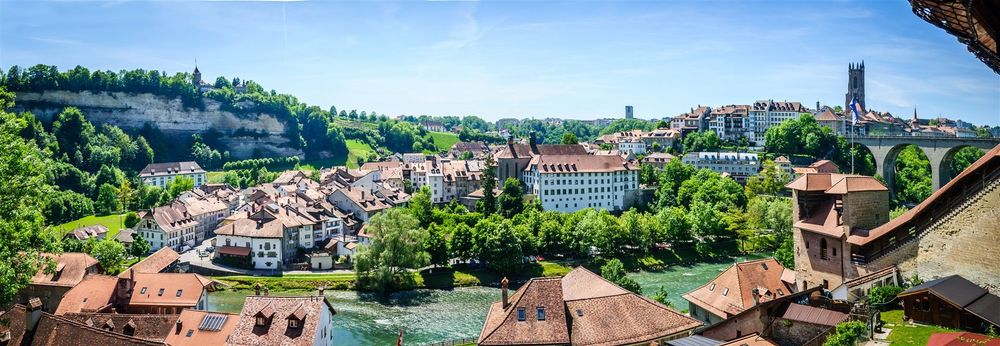
Fribourg is built on two levels. Down in the loop of the Sarine stands the medieval old town of molasse sandstone, reached by narrow, steep lanes and stepped paths; up on the plateau are residential and commercial buildings, the university and the bridges that connect the two parts of the city. Anyone who wants to rent aerial work platforms and construction machinery here therefore plans the route to the set-up point and the area that has to stay clear there before planning the working height. Luibl rents out aerial work platforms, telehandlers, excavators and forklifts to restoration and stonemasonry firms, facade and building services companies, construction contractors and municipal depots in the city and across the rest of the canton of Fribourg. We make the selection along the conditions on site: access, gradient, load-bearing capacity of the ground and the required outreach.
Molasse sandstone: restoration without pressure on the facade
The building fabric of the lower town consists almost entirely of molasse sandstone. The material is soft and absorbent, it weathers at edges, cornices and window surrounds, and it tolerates no contact pressure. For joint repair, stone replacement, cleaning and the maintenance of roof structures this produces a clear requirement: the machine never braces itself against the facade, and the platform is guided calmly along the wall instead of being driven into it. Whether a position can be reached is therefore decided less by height than by outreach. Articulated boom lifts with 10.89 to 48.15 m working height work from a distance and guide the platform over porches and retaining walls right up to the wall.
The second point is the ground. In the lanes, cobbles and slab paving lie over cellars, vaults and service ducts — the surface looks load-bearing and is not so everywhere. Load-spreading plates are part of the basic equipment, and the permissible point load should be clarified before the first machine rolls up. Where there is no room for outriggers, tracked lifts with 13.00 to 39.50 m remain the most practical class: narrow transport width, load distributed over the tracks, an undercarriage that also reaches the set-up point across stepped forecourts and sloping approaches. Because the steep slope stacks retaining walls and terraces on top of one another, the permissible gradient of the set-up area counts as well — machine-dependent and documented in the operating manual.
Bridges, tall buildings and the tasks of the upper town
Above the loop the requirement profile shifts. Here it is about bridge structures over the river bend, about residential and commercial buildings with several full storeys, about university and administrative buildings and the associated services: lighting, cabling, waterproofing, railings, drainage. Pure height is called for more often than in the lower town. Telescopic boom lifts cover 14.00 to 56.90 m working height with 227 to 454 kg platform capacity and work tall facades, piers and abutments from a position that has been set up once.
For soffits — service runs beneath the deck, bearings and joints — a machine is needed that first takes the platform up and then under an edge; the diesel articulated boom lifts range from 11.91 to 48.15 m with 227 to 450 kg. On paved, level ground diesel scissor lifts with 9.70 to 34.00 m and up to 1,134 kg platform capacity are the more economical solution as soon as several people have to go up with material at the same time. At the connecting structures the traffic management also decides matters: a closed lane or a time window at the edge of peak hours determines how long a machine may stand. Let us know the approved window and we will align delivery and collection with it.
The rental fleet in figures
| Class | Working height | Platform capacity |
|---|---|---|
| Scissor lifts, electric | 6.30 – 33.00 m | 227 – 1,000 kg |
| Scissor lifts, diesel | 9.70 – 34.00 m | 363 – 1,134 kg |
| High-bay scissor lifts | 18.50 – 33.00 m | 450 – 1,000 kg |
| Articulated boom lifts | 10.89 – 48.15 m | 150 – 450 kg |
| Telescopic boom lifts | 14.00 – 56.90 m | 227 – 454 kg |
| Mast lifts | 10.00 – 12.65 m | 200 kg |
| Tracked lifts | 13.00 – 39.50 m | 200 – 400 kg |
Moving material between the lower town and the plateau
The difference in height between the parts of the city makes material transport a task in its own right. Telehandlers in rigid form lift 1.25 to 25 t to 4.30 to 18.80 m and set down scaffolding material, stone packages or windows over walls and embankments; the roto version with 15.42 to 38.90 m and 4 to 8 t delivers the same reach without repositioning the machine. For halls and emission-sensitive areas there are electric telehandlers from 5.85 to 30.00 m.
In pipeline and civil engineering work the fleet of excavators covers 1.8 to 30 t operating weight; in the historic centre the small end is almost always what is called for, because lane width and turning circle dictate the class. Added to this are forklifts from 3 to 16 t for handling in municipal depots — and where even a telehandler no longer fits through, the mini crane.
Operator duties and instruction in two languages
Swiss occupational safety law applies in Fribourg. The framework is set by the Labour Act and its associated ordinances; the operator duties for the use of work equipment are governed by the Ordinance on the Prevention of Accidents and Occupational Diseases (VUV). Implementation and supervision lie with the Swiss National Accident Insurance Fund (Suva), and the guidelines of the Federal Coordination Commission for Occupational Safety (EKAS) set out the requirements in detail. Mobile elevating work platforms are inspected to SN EN 280. Luibl hands over every machine with an inspection certificate, CE documentation and operating manual; risk assessment, protective equipment, a rescue plan for the platform and the visual and function check before work begins remain with the hirer.
One point that comes up here more often than elsewhere: the city is bilingual, and on mixed sites German-speaking and French-speaking teams work on the same machine. Clarify before you begin who gives the instruction, in which language it takes place and which version of the operating manual is kept with the machine. The same applies to barriers, emergency procedures and communication between the platform and the ground.
Transport to Fribourg
Transport runs from our Passau site; the distance is around 700 kilometres. Up to the edge of the city the approach is unproblematic; the actual planning begins in town. Between the plateau and the loop the streets fall away steeply, hairpins and archways limit the length and height of the vehicle, and in the lower town a single bottleneck often decides whether a low-loader reaches the destination. Tell us the width at the narrowest point, the clearance height, the gradient and the turning option at the destination — from that it follows which machine size comes into question. If your project runs across several locations on the Swiss Plateau, for instance additionally in the Bern area or in Lausanne, we coordinate delivery, machine changes and collection through a single contact.
Frequently asked questions
Which aerial work platform is suitable for restoration work on molasse sandstone?
One that works from a distance. The sandstone tolerates neither the platform bumping against it nor the machine bracing itself on the facade, which is why outreach matters more than height. Articulated boom lifts with 10.89 to 48.15 m working height guide the platform over porches and retaining walls up to the wall. For the selection we need the height of the work position, the distance to a load-bearing standing place and the clear area.
How do you set up a platform in the narrow lanes of the lower town?
After clarifying three points: where outriggers may be placed, how high the permissible point load is, and what lies beneath the surface. Cobbles and slab paving sit over cellars and service ducts in many places here, which is why load-spreading plates are standard. If the area is not sufficient, a tracked lift with 13.00 to 39.50 m is the alternative: the tracks distribute the load, and the machine gets through in a narrower form.
Which machine reaches a bridge soffit over the river bend?
One with an articulated boom that first raises the platform and then guides it under the edge. Diesel articulated boom lifts from 11.91 to 48.15 m working height with 227 to 450 kg cover the greater part of these tasks. The standing place is decisive: load-bearing, sufficiently level, correctly positioned in relation to the work position. For the design we need the distance, the difference in height and the platform load.
Does the instruction have to be given in German and French?
It has to be given in a language the operators understand reliably — with mixed teams that often means both. Determine before work begins who gives the instruction and which version of the operating manual stays with the machine. The responsibility lies with the hirer as operator; we provide the documents and agree the language version at the enquiry stage.
How much lead time does a job with a closed lane need?
As much as the permit needs — this lead time is practically always longer than that of machine scheduling. Secure the time window first and align the machine with it, not the other way round. As soon as the date, duration and location are settled, we plan delivery, familiarisation and collection so that the time in the window remains available for the work.
Before you enquire, it is worth looking at the designs: at Rent a lifting platform you will find all platform types from the scissor lift to the truck-mounted platform with their strengths, typical applications and operator duties.