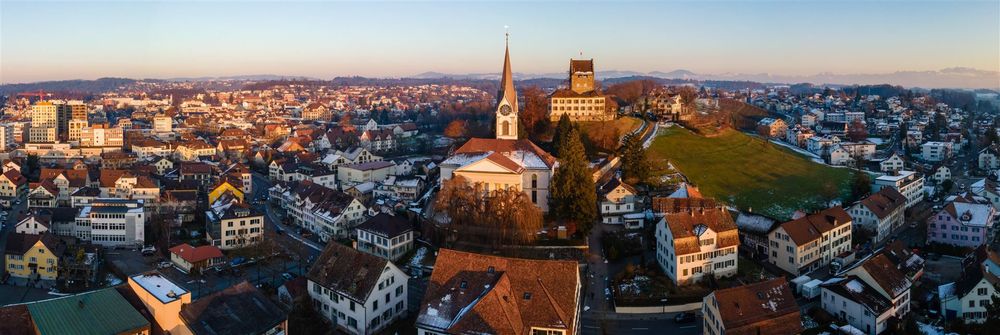
Rent aerial work platforms and construction machinery in Uster
Anyone looking to rent aerial work platforms and construction machinery in Uster is frequently dealing with existing buildings in the Zurich Oberland. Along the Aabach stand the spinning and weaving mills of the 19th century, which are today being converted into offices, studios, commercial space and flats: brick facades, timber-frame structures, cast iron columns, sawtooth roofs and generous window areas. Buildings of this kind do not forgive a standard solution. Alongside them, modern commercial zones with hall and warehouse technology have developed. Luibl delivers inspected hire machines for both worlds to the place of work in Uster and the Oberland on its own low-loader.
Brick, timber frame and sawtooth roof: working on historic building fabric
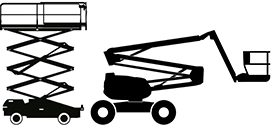
At an old factory building, the ground in front of the building is often the bigger problem than the facade itself. Paved courtyards, filled bank embankments, culverted channels and old service lines limit what may be set up. Spider lifts with 13.00 to 39.50 m working height and 200 to 400 kg platform capacity are often the only machine here that gets to the wall at all: they distribute their weight over the track area, travel over soft ground and pass through courtyard entrances that are too narrow for a wheeled machine.
For joint repair, cramping, stone replacement and window junctions, the ability to work close to the wall and to get around projections also counts — cornices, pilaster strips, canopies, lift oriels. Articulating boom lifts with 10.89 to 48.15 m working height are made for this, because their platform can be taken across an obstacle to the facade. Where the facade is freely accessible but far away — above a watercourse or an embankment, for example — reach for telescopic boom lifts with 14.00 to 56.90 m. Important with all versions: spreader plates under every outrigger, and before setting up, establish what lies beneath the set-up area.
New services in old structures: interior fit-out under sawtooth roofs and timber beam floors
Inside, the task changes character. After the old fittings have been stripped out, ventilation, sprinklers, electrical distribution, data technology and lighting have to go into a structure that was never intended for them. Work takes place between timber beams, steel girders and sawtooth roof trusses, usually above a floor slab with limited load-bearing capacity. Electric scissor lifts from 6.30 m working height are the standard machine for this: locally emission-free, with non-marking tyres and with a platform that takes duct sections and tray components up with it.
In the narrow circulation axes of old factory floors — stairwells, connecting corridors, light wells — a scissor lift often cannot be set up. Here a mast lift with 10.00 to 12.65 m and 200 kg platform capacity delivers what is needed: it fits through standard doors, is light enough for many existing floors and can be repositioned by one person. Have the permissible imposed load of the floor checked before the assignment and record the result in writing — in buildings of this age the structural design is not a side issue but the precondition for the choice of machine.
The rental fleet in numbers
| Class | Working height | Platform capacity |
|---|---|---|
| Scissor lifts, electric | 6.30 – 33.00 m | 227 – 1,000 kg |
| Scissor lifts, diesel | 9.70 – 34.00 m | 363 – 1,134 kg |
| High-rack scissor lifts | 18.50 – 33.00 m | 450 – 1,000 kg |
| Articulating boom lifts | 10.89 – 48.15 m | 150 – 450 kg |
| Telescopic boom lifts | 14.00 – 56.90 m | 227 – 454 kg |
| Mast lifts | 10.00 – 12.65 m | 200 kg |
| Spider lifts | 13.00 – 39.50 m | 200 – 400 kg |
Telehandlers, excavators and forklifts for conversion work and the commercial zone
Changes of use generate movement of material in both directions: rubble out, new services in. Telehandlers are the workhorse for this — rigid machines with 4.30 to 18.80 m lift height and 1.25 to 25 t capacity for the courtyard, roto models with 15.42 to 38.90 m and 4 to 8 t where loads have to be set down across an existing wing of the building without repositioning the machine. In enclosed areas, electric telehandlers with 5.85 to 30.00 m and 2.5 to 7 t work without exhaust fumes.
For drainage, service line and foundation work between existing buildings, excavators from 1.8 to 30 t operating weight are available; the small classes also get into a courtyard that can only be reached through an archway. In the commercial zones of Uster, forklifts from 3 to 16 t and high-lift stackers with 2.70 to 5.50 m lift height and 1.2 to 2.0 t capacity supplement the fleet. For racking and ceiling services in the warehouses there, high-rack scissor lifts with 18.50 to 33.00 m are additionally available.
Operator obligations when working on existing buildings
Precisely in conversion work, where shell construction, fit-out and heritage conservation are on the same site at the same time, responsibility for the machine has to be unambiguous. Legally, Swiss law applies in Uster: the Ordinance on the Prevention of Accidents and Occupational Diseases (VUV) forms the basis, implementation and supervision lie with SUVA, the directives of the Federal Coordination Commission for Occupational Safety (EKAS) make the requirements specific; above these stand the Labour Act and its associated ordinances. The recurring inspection of mobile elevating work platforms is carried out in accordance with SN EN 280. Luibl provides an inspection certificate, CE documentation and operating manual with every machine. With the hirer remain the risk assessment for the specific set-up location — with existing buildings including the question of floor load capacity and ground conditions — the instruction of the operators and the visual and functional check before work begins.
Transport to Uster
The approach to Uster along the main routes of the Oberland is straightforward; it only becomes demanding at the property itself. Old factory sites have courtyard entrances with restricted clearance height, cobblestones, tight turning circles and occasionally weight restrictions on access bridges over the Aabach. Tell us with your enquiry the clearance dimensions, the surface of the set-up area and the planned position of the machine — from these it follows whether a tracked machine, a compact wheeled machine or a set-up from the street is the right solution. For larger building projects we coordinate the scheduling with the locations in Zurich and Winterthur.
Frequently Asked Questions
Which platform reaches a brick facade with an unsurfaced area in front?
Usually a spider lift. With 13.00 to 39.50 m working height and an undercarriage that distributes the load over the track area, it reaches set-up locations where a wheeled machine would sink in or damage the surface. With projections such as cornices or canopies, the articulating boom lift has the additional advantage that its platform is taken across the obstacle. Spreader plates under the outriggers are mandatory in both cases.
How heavily may an aerial work platform load an old timber beam floor?
That is not decided by the machine but by the structural design of the building. Have the permissible imposed load of the floor concerned checked and documented before the assignment; only then do we select the machine. In many factory floors what remains in the end is a mast lift with 10.00 to 12.65 m working height and 200 kg platform capacity, because it has the lowest dead weight and can be repositioned point by point.
Can I work in Uster inside a courtyard that is only reachable through an archway?
Often yes, but the archway determines the machine. What is decisive is the clear height, the clear width and the turning circle behind it. Compact electric scissor lifts and mast lifts fit through most historic archways; tracked machines also get through, but need protection for sensitive surfaces. Measure the narrowest point and send us the dimensions with your enquiry.
Do I necessarily need an electric machine for interior fit-out in a factory hall?
In enclosed rooms, practically always. Electric scissor lifts from 6.30 m working height are locally emission-free and run on non-marking tyres — important on refurbished industrial floors, ground concrete and newly laid coverings. Diesel machines stay in the yard and on surfaced external areas. For projects that call for both, scheduling two machines makes more sense than a compromise.
Which machine brings ventilation and sprinkler components in under a sawtooth roof?
For work over an area, an electric scissor lift, because its platform carries material and several people and the run can be worked through section by section. If individual points above fixed installations have to be reached, the articulating boom lift is the better choice. For delivering heavy components onto the floor or the roof, combine the platform with a roto telehandler, which reaches from 15.42 to 38.90 m.
Working height, outreach and ground conditions determine the right machine. A comparison of all designs with costs and inspection duties is available at Rent a lifting platform: platform types, costs and applications.