
Rent forklifts in Dresden: 53 models from 1,200 to 33,000 kg
You can rent forklifts for Dresden from Luibl Rental from a fleet of 53 models: electric, diesel, gas, all-terrain and heavy-duty forklifts as well as high-lift stackers with 1,200 to 33,000 kg capacity. Whether a pallet warehouse in the north of Dresden, a trade fair set-up in Friedrichstadt or a machine relocation in a plant: first the weight of the heaviest load including its load centre counts, only then drive and tyres. This page therefore sorts the fleet by capacity class and shows where in Dresden which class is needed. Delivery is from our location in Passau.
Rent forklifts in Dresden: the capacity class decides first
Anyone who chooses too little capacity cannot lift the load safely. Anyone who chooses too much gets a wider and heavier forklift than the hall, door and floor can take. The four classes below cover the entire forklift rental fleet.
| Capacity class | Types in the fleet | Typical use in Dresden |
|---|---|---|
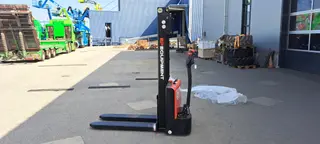
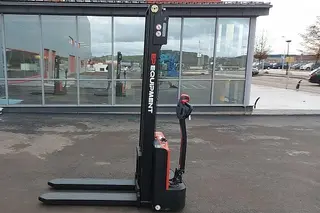
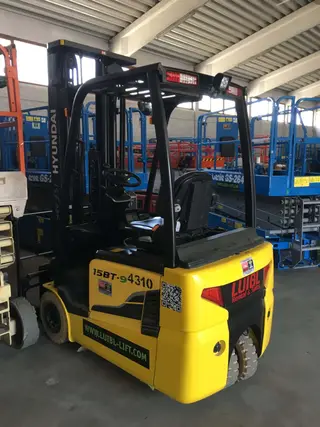
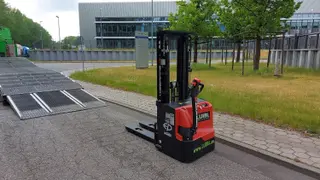
| up to 2,000 kg | high-lift stackers (1,200–2,000 kg), electric forklifts from 1,500 kg, gas forklifts from 1,800 kg | halls in the north, laboratories, Messe Dresden |
| 2,000–5,000 kg | electric, diesel and gas forklifts, all-terrain forklifts (3,000–5,000 kg) | logistics on the A4, A13 and A17, building materials on construction sites |
| 5,000–10,000 kg | electric and diesel forklifts up to 10,000 kg, gas forklifts up to 7,000 kg, heavy-duty forklifts from 8,000 kg | Alberthafen, steel, long goods, heavy pallets |
| over 10,000 kg | heavy-duty forklifts up to 33,000 kg (Kalmar DCG 330-12T) | machine relocation, plant and factory construction |
The fleet comprises 22 electric forklifts, 11 diesel forklifts, 3 gas forklifts, 4 all-terrain forklifts, 7 heavy-duty forklifts and 6 high-lift stackers. The rated capacity only applies at the load centre according to the capacity chart, usually 500 mm for smaller forklifts. If the centre of gravity is further forward or you lift high, the residual capacity decreases. So plan with a reserve.
Up to 2,000 kg: high-lift stackers and electric forklifts for halls and the trade fair in Dresden
In the lightest class the machines almost always work under a roof. There, exhaust fumes, turning circle and floor load count more than off-road capability.
Halls in the north of Dresden: electric drive without exhaust fumes on site
In the semiconductor and electronics companies around Klotzsche, Hellerau and the airport, electric forklifts are used because they produce no local emissions during operation. For racks in narrow aisles, high-lift stackers with 2.70 to 5.50 m lifting height are suitable. Clarify the plant registration, the permissible surface load and a charging point with a socket in advance.
Messe Dresden in Friedrichstadt: clarify approval in advance
At trade fairs and events on the exhibition grounds at Ostragehege, the organiser often determines who may drive in the halls with their own forklift. So ask before renting whether third-party machines are allowed. In the halls an electric forklift fits; on the outdoor area a gas forklift is also an option.
2,000 to 5,000 kg: forklifts for logistics and construction sites in Dresden
This class is the broadest in the fleet. Here the ground decides whether a hall forklift is sufficient or an all-terrain forklift is needed.
Logistics on the A4, A13 and A17: electric in shift operation, diesel in the yard
Warehouses and handling areas along the A4 and at the Dresden-Nord junction often work in several shifts. Electric forklifts lift up to 6.00 m but need charging times or a swap plan. For unloading lorries outdoors, a diesel forklift with 4.50 to 6.00 m lifting height is suitable. A gas forklift shuttles between hall and yard, provided the risk assessment permits operation in the hall.
Construction sites in Gruenderzeit quarters and on the Elbe slopes: all-terrain forklifts
On construction sites in Striesen, Pieschen or the Outer Neustadt, all-terrain forklifts are used: Manitou M30-4 and M50-4 as well as Ausa C300H and C500H x4 with 3,000 to 5,000 kg and 4.75 to 5.45 m lifting height. If the forklift is parked on public ground, you need a permit from the state capital Dresden. On the slopes in Loschwitz and Weisser Hirsch, drive with the load facing uphill and slowly. In the Elbe floodplain soils become soft after rain; a paved track helps there.
5,000 to 10,000 kg: forklifts for port, steel and long goods in Dresden
From 5 t the use shifts to handling and metalworking. Width, dead weight and fork length become planning factors.
Alberthafen in Friedrichstadt: diesel forklifts for handling
At Alberthafen on the Elbe, steel, building materials and general cargo are handled. Diesel forklifts up to 10,000 kg are suitable for this. Access, quay edge and parking areas are regulated by the port operator, so agree the job there in advance. For long goods, give us the length and weight so that fork length and load centre fit.
Factory halls: electric forklifts up to 10,000 kg
An electric forklift also moves heavy pallets and coils in halls. In the fleet it goes up to 10,000 kg capacity. Check the door clearance and hall floor, because the dead weight increases considerably with capacity.
Over 10,000 kg: heavy-duty forklifts up to 33 t for machine relocations in Dresden
For machines, moulds and plant components, 7 heavy-duty forklifts with 8,000 to 33,000 kg capacity and 4.50 to 6.07 m lifting height are available. The largest model is the Kalmar DCG 330-12T.
Check the route: doors, floor and gradient
In a machine relocation the load is rarely the problem, but the route to it. Measure door width and height, clarify the load-bearing capacity of the hall floor and avoid gradients. If a machine's centre of gravity is off-centre, you need a reserve in capacity and a plan for setting it down.
Limit at 6.07 m lifting height: telehandler or mini crane
No forklift in the fleet lifts higher than 6.07 m. For loads onto scaffolding or over parapets, use a telehandler; in tight halls and inner courtyards, a mini crane in Dresden.
Transport to Dresden: around 470 km from Passau
From Passau it is around 470 km to Dresden, usually via Regensburg, the A93, the A72 and the A4. We schedule the transport for you; an early request makes planning easier. At the unloading point we need a passable access route, firm ground and enough space for unloading. In the city centre a no-stopping zone is often required for this. The same route applies to Radebeul, Freital, Pirna, Heidenau and Meissen. For western Saxony you will find information under forklift rental in Chemnitz. Aerial work platforms for facades and hall ceilings are listed under telescopic boom lifts in Dresden, more machines on the page construction machinery rental in Dresden.
Duties for forklifts in Dresden: DGUV Regulation 68 and DGUV Principle 308-001
Even a rented forklift may only be driven by qualified staff. The duties are shared between driver and operator.
Driver: trained, authorised and at least 18 years old
Under section 7 of DGUV Regulation 68, a forklift may only be driven by someone who is at least 18 years old, suitable and trained, has demonstrated their competence and has been authorised in writing. Training follows DGUV Principle 308-001. Via certified partners we arrange training for you free of charge and without obligation.
Operator: risk assessment and instruction
The operator assesses the hazards at the site under section 3 of the Industrial Safety Regulation (BetrSichV) and instructs drivers under section 12 of the Occupational Safety and Health Act (ArbSchG) and section 12 BetrSichV. This includes routes, pedestrian areas, ramps and, for gas forklifts in halls, ventilation.
Request a forklift for Dresden: load, lifting height, location
With these details we will suggest the right forklift:
-
Weight, dimensions and centre of gravity of the heaviest load
-
Required lifting height
-
Use in the hall, outdoors or both
-
Ground and access at the site in Dresden
-
Start of rental and planned duration